
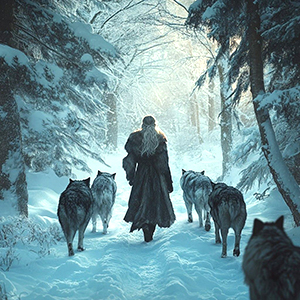
FOREST PEOPLE
Crack. The resin buried deep within the log could no longer remain dormant under the intensity of fire. The tiny explosion adjusted the blaze in the hearth. The embers momentarily opened their impossibly red eyes and a shower of sparks sprayed up the chimney.
Fáith is not distracted. Not one part of her. She holds the ash shaft securely in the vice while she shaves fluff from within the follicle of a feather.
She takes it gently between the tweezers and releases the vice. She uses the tiny badger hair brush to line the follicle with a breath of glue. She fixes it to the wood, equidistant from the two white gander feathers. They face towards the bow. The black, the king fletch—the goose fletch—faces away. She does this arrow after arrow. Hour after hour.
Outside the cottage is a world of silence. That certain blue that only seen on a frozen landscape at night. No wind. Utter stillness. Air thin. Birch and rowan bejewelled with icicles, spruce tufted with snow, ground thick with it, both powder and firn.
Wolf lies on his rug at the grate, his lids half closed, his head on his forepaws. Both he and Fáith are at peace, relaxed. Like sister and brother from the same mother, their hearing is flawless. If a sound is heard—the jangle of a bridle, the kick of a heel against a flank, the sound of breath, they will hear. From miles away. Whether on foot, on horseback or riding the reindeer-pulled sled, if the otherkind try to approach, the two will be gone. There is no other way to travel this far into forest. Any petrol-driven vehicle will run out of fuel at least a day before it reached this remoteness.
Fáith was not born here but she has grown up here. She is this place.
Da lived to forty but Mam died when her child was just one year old. Da and wolves had stalked the kill with Fáith secured to his back in a finely crafted leather-and-weave cradle board. To get her used to territory. Mam had hunted those razor-toothed, iron traps the otherkind ordered set to catch wolves. Or people.
She’d missed the one that took her leg off at the ankle. Mam died before Fáith’s Da found her; blood like crimson butterflies on the snow, Mam seemingly the creature itself, just sleeping.
Fáith knew they were after her. Them who call themselves Church. That crazy species of two-legged otherkind with their vengeful god. A belief their species was superior and chosen. That hers must be saved. Brought in and saved. She knew they lied about forest and snow people, indigenous hunter gatherers.
Wolves are always wild. There is no such thing as a tame . When Church had first contact with us they had thought wolves that travelled with us were domesticated. They shot anyway and those not struck down had fled, the people not shot rounded up and herded. Forced to walk that long walk. It was only then that Church realised two-legged, and four, were pack; that both were wild. Their word wild that was the confusion. Tame was what? Safe?
Tame is not safe, Fáith muses as she attaches a nock and a broadhead to each of the twenty four arrows. Tame is trapped.
To make this forest safe for their enterprise the Patron, the leader of Church; of those who claimed ancestral lands before the burning of vast tracts of forest, before the railway, before the cities, devised a systematic hunting of us. When they worked out how to parley, interpreters gave clans two choices: adapt and settle in the cities or live on land allotted them. Land without forest. Reservation. Make do and not hunt anymore. Have nothing to do with Wolf.
Some people thought adaptation might provide better for their families in the fast-growing cities. Working for the foreigners. They left the reservation. Lived in small rooms, crowded, upright coffins. Cinderblock flats. Alcoholic. Shunned because of the slight slant of eyes, clan tattoos. Thought of as barbarians. Eaters of raw dead.
People ate what shop owners sold . They ran up debts because they did not understand money. White flour and bread. Sugar, a new food. Canned stuff. What meat could be pilfered was old or rancid. No fish. They worked the roads to pay their bills. Had nothing. A relentless cycle. Subject to disease, liver failure and diabetes. They got fat and died young. Vhildren lost language and lore.
Many who used to live where Fáith now sleeps fought back. From the tree line, not wanting to venture onto the wrongness, now pasture where once the forest knew freedom; habitat and mother. From before time. They all died. They brought down a merciless punishment on the women and children, the elders, who not resisted. It was all slaughter. Forty-seven years ago. hurch had guns. Fáith’s people? The axe and the bow.
Fáith’s parents were second generation reservation people. Da and Mam become lovers because their parents were close: knowledge holders. From different clans they shared secrets. Clandestine. Those secrets, and ancestral lore of both clans, were told to Da and Mam. In case of hope. In case of a future. So that the knowledge of who people truly are did not vanish from the world.
Her parents escaped, and it was years before their absence came to the attention of authorities. Punishment was the murder of knowledge holders, including Fáith’s grandparents.
Mam and Da knew how to call Wolf in the correct manner. Politely. To honour the hunt trails. Honour the kill. Stay alive. Live well. Follow dragon lines — the ancient tracks the nomadic must travel to honour seasons of the year.
Wolves understood the nuance of the language of their two-legged cousins. They hunted and shared hearth for millennia. They remembered. They led the runaways to the furthest, still untainted territory within the forest where life is isolation. Where Fáith was born. Wolf, upon his rug, is the son of the pup placed within her crib on the day of her birth. Fáith has lived twenty winters and this pup, five.
The second last thing she does for the night is to clean the tools Da made for her. Put them into their individual compartments of the chamois bag with the straps. Stow this into the pack—tough leather, reindeer hide—that she keeps beside the door alongside the quiver of twenty-four arrows, just below the frame that supports a recurve bow. Da made that for her from the wood of the mountain ash just a year ago. He crafted it especially for her. She was given it the night of her initiation. The night Da inked the first of her clan tattoos into her face with ink made from the soot of the mountain ash. Perfect blue lines from left ear, across her cheek, over nose just below her eyes and on to her right ear.
Just months after he did this for her Da died. She gave him to the crows and hawks and bears, the way she had been taught. For all of us are food.
The last thing she does is to pull down snowshoes. Wolf is instantly on his feet. He paws the door in anticipation.
They move in silence. Deep into forest. Far enough so that smells of their urine will not attract anything back to the cottage.
That night they sleep curled together on the rug before a banked hearth, like puppies, the smouldering back log sending off no sparks. How it is done.
The next day they hunt from the hint of silver-pale predawn until well into blue and shadow of night. Fáith carries all weapons and wears the pack on her back. Game is scarce this deep into winter. They bring down two hares. White. Only visible by their movement. Fáith shoots one and has time to slit it from throat to groin, gut and skin it before Wolf finally stops tormenting the other, snapping neck. A race the hare would have won a month earlier or a month later.
Wolf carries the quarry back, tossing it high in the air and pretending it is still alive. Fáith eats rich, warm liver and the heart of her kill, tossing remaining offal to Wolf. She guts and skins his trophy before returning it to him whole. As is fair.
Winter fur. Good hides. She will use them to thicken the lining of boots.
Splitting the silence of the night, a jangle of harness. A baying. Fáith and Wolf are instant stillness. Which direction? They waited. To the south was the high squeal of a winter hawk echoes through rarefied air. Warning.
Now attuned, they wait. Enemies are many miles away. Still unknowing. The advantage with the hunted.
The whuffle of a horse’s nostrils, the snow giving way beneath hooves. Four horses. Two hounds. That suggests four men; less probably because they’ll need at least one horse for supplies. Even odds unless they have rifles. They will have rifles.
And the scent of blood is upon snow. The red of it a deep stain. None of the hunters will know what was killed or by what. Woman and Wolf still hold advantage.
The otherkind burn the cottage but she is not attached.
They run. Most of the night. Mile after mile deeper into the snow, higher into the alpine raw.
Daylight is four hours of grey becoming white becoming grey with no horizon within perpetual mountain. What’s the plan? None. Not anymore. They follow caribou trails north through nights lit by green and amber borealis, grandmother of rivers, teaching the sorcery of silence that brooks and burns are too young to comprehend. It is a silence of the oldest boulders that pock tundra.
She gathers kindling and easy to snap elder wood, uptorn roots from this or that ancient storm, for nightlong warmth. She builds fire to the side of an entrance of shelter to dissuade curious predators from trespassing a sleep of peace. These sanctuaries are lava tubes, remnants of mountain’s savage and molten history, countless millions of years ago.
Freedom. No domination. She will not betray ghosts. If they are all that remains, so be it. They are these mountains, this snow, ways of thunder and black water beneath frozen river. The two are bonded for life and, while with this land there is no death.
They sleep curled together for warmth beneath a vault of the blue ochre handprints of once-upon-a-time children.


This reading is a breath of fresh air. Thank you. I woke thinking of you in the dark morning hours. I hope time is treating you well.
Fondly,
Earthwind
Earthy! How good to hear from you. Time is a bit of a buddy, I guess. lydeangeles@gmail.com. Pop me a line there. We are overdue for a face-time xx