For the skellig read thorugh
Gamble and Terrence exposition
For the skellig read thorugh
Gamble and Terrence exposition
A LITTLE WEIRD
Oh, you do come across as a little weird. Someone with that many tattoos can’t be trusted. Can’t be introduced as someone serious or quite sane. A bit peculiar. A bit of a fruit loop, you must understand. Too old for those piercings. Too…
I am not like you.
The adopted people he [Dr Paul Sunderland] sees often appear very well put together.
They rarely talk about being adopted – it’s just by the way. When he does a bank of psychometric tests, he finds these people score very extremely high on the measure of depression, but you can’t actually see it. Sunderland[1] began to question what this was about and found there is an awful lot these people have in common…
When I was young I wanted to be like other children. To get princess compliments. No, not from my ‘family’. That was never an option. From those other children. It didn’t happen, of course. It couldn’t happen. They instinctively knew I was not one of them. By the smell of me, perhaps. That I was wrong, in some way they wouldn’t have been able to articulate, even if asked. So I just achieved more than was fitting for a girl. For a while. Endorphins are interesting like that.
Over the years it became easier to be different. There was a precedent. The era was ripe. They were promiscuous, skinny-jeans-wearing, black-lipstick days of anarchy and political disobedience, of nights sneaking out of windows to have sex in darkened laneways up against a wall. Times of poetry and ritual, war and rage and loud music… and of rejection for being different. Because I was not like them, and even though the era gave the hope of freedom to other girls, I was trapped. I would never be them.
I was born a mammal. Squeezed from an unwilling vagina, cut and washed and wrapped in something to prevent my fists from pounding air. Popped into a small hospital box and put up for sale. Nothing smelled like me. No flesh, no nipple, no sigh, no grunt at the force of my suck, no eyes locked to eyes. Did you know that of abandoned children? That immediate and irreversible fear of death is our first breath? Our first milk fed to us through rubber? The hands that powder us and pin us to a diaper, a stranger’s hands? Brisk and efficient. Paid for by a hospital?
…
An abandoned child’s neurons are, at birth, irrevocably confused because there is supposed to be oxytocin. And a name. A future. A designation.
We I am not like you because I was not in the company of the person belonging to that vagina.
For the adoptee there is real fear in relationships. There is a great desire or hunger to attach, causing you to sometimes behave against your best interests, but with the conflicting feelings that this is not safe. The feelings are held in the limbic system which will always override the frontal cortex…
And no one speaks of it again. Or if they do, in later years, it is impossible to fix those broken neural pathways. Besides, it is with the voice of shame. Or with a thinking mind of I know-ness. When that is impossible because the person doing that thinking is not the relinquished person. Will never know them, because in their brain is another brain. A limbic thing of several billion electrical
impulses. Ancient and primordial. Reptilian, in fact.
That brain is not wired like yours.
When an unborn mammal is floating in the sea of an amniotic fluid for that full and airless inner lifetime, from conception to eruption, we heard the thunder of a thousand heartbeats, from organ to pulse to excitement to rage. I turned in languid sensual seal-movements, to the rumble and gurgle of bodily secretions passing along and through that glorious universe of unrealized digestive tract. The rush and whir of lung-life. The contraction of some mythic, external winter-on-skin, the grunt and rush of a masturbated orgasm. The magnesium hit of ocean-in-summer. Roller coasters of standing and lying and bending and shitting and rolling over in the night. I was prepared. An eternity of DNA and cells and neurons all promising suckle. And safety.
That never comes. So this is death. At the first breath, and the breath after and the breath after that. Left on the grass of a savannah with eagles and buzzards circling. Caul not licked off. Legs unable to stand, let alone find an udder or a pap. Lying there. Ready to be eaten. Carrion for any scenting hunter.
To never look into eyes and see yourself. Yourself in the turn of a smile. The behavior that says like mother like daughter. To never, until ejecting young from a woman-body, smell someone whose scent is like you. You think we are like you? You really think that?
…
THIS brain is not wired like yours. You might think so, but you are wrong.
The normal biology of pregnancy has the baby set up for bonding with its mother, and the mother who relinquishes her baby goes against her biology. The child experiences life-threatening abandonment. The ‘chosen child’ is the story of a child entering a family that does not genetically fit them, with an impossible job description to be someone they can never be.
We are achievers, or we are dead. By our own hands. Quite often both. One step ahead of the bullet, the blade, the syringe or the top of a tall building, the bottle. The sentence that says, in truth, you have no right to be alive. You are a sin. You are a bastard. You have brought shame upon someone you never met. Their parents. The church. You are the get of a slut. Fallen from grace. Of no name until bought. Claimed. Your new, ‘real’ identity recorded within the appropriate department of an establishment for such people as what came from so much badness. Who could not be a citizen without the legitimate banding of some man who had the money to afford their price. Who could keep his wife’s infertility a secret. If indeed that was the case. Yes, we were recorded in some register, somewhere, as an actual entity, a human being, now acceptable within the culture of both the sellers and the buyers. Paid for by a legal document. Signed into a life with strangers by a court of law.
A child now owned, and everyone pretending I belong. People playing with belief. Playing love. Causing harm. In uncountable paper cuts or other ways, unmentionable ways, humiliating and confusing to a child. Them saying, but you like it, don’t you?
But we are not like them and they do not know that, except by the look of us, so utterly unfamiliar to any of them. They thought we would comply with the pretense of family. They thought we would be a proper kid. How? We don’t know how. This is not in the handbook of the neuroscience that I we are wired for, in that ceaselessly noisy prepartum ocean. The umbilicus feeds this person something else. An ancestry that dates deep to within the sea of stars from which we all come, and something else. Before that. The atomic roar and electron kaleidoscopic particle accelerator that exploded one cell into two, with the ramming of that unrelenting sperm into that other woman’s vast and eager egg. Therein is written another story. An old, old one. That handbook said you belong! You will belong! But it unwittingly lied. That doesn’t happen. It never happens.
I am now an elder, and my relationship with rejection and shame, my intimacy with achievement and excellence, depression and isolation, is as private and unknown as the secret, hidden insubstantial fluff of a newborn empress penguin, called an emperor, raised and brought up amongst sea lions, too wet and too huge to do more than to show her that she cannot be satisfied by them, but neither is she able to know she is not one of them.
This relationship is that of the twenty one stairs in our house that I threw myself down, in an attempt to die at seven, to Valium and the acceptance of violating sex, to the wonder of understanding raven conversations, prophesy and wildness, and the dreams of the smells of a forest of fir and aspen, in a landscape I have never trod. It is an unquiet fear of nothing, that is sometimes, also, the dark, deep bottomless ocean that yes, fuck it, is occasionally a terrifying suffocation because I can never really swim to the surface.
…
AM ERASED person is not like you. You might think so, but you are wrong. I am not wired like you.
I’m adopted, I say, to someone who’s not knowing, even as I speak, that the words will only sound like the same language. Note I did not say stolen.
I wish I’d been, they sigh, giving me an opening to ask why that I refuse. As every time before.
Really? I reply, hiding this unquenchable rage with the look of guilelessness that has kept me from an asylum most of my life. The look on my face is benign. Benign with practice. On the inside I am unavailable to anything except as a deep-dark-water-drowning-person who is wishing, right now, to be aboard a saddled and gaily-tasseled camel wandering a desert in another part of the galaxy. Rather than have begun this conversation.
You think that would have made your life better? I smile.
Poker was a game, mastered in the company of a bloke-full of butchers, preferred to the threat of idleness (or even books). I only win if I play with matches, however, because addiction is such an easy hole to fall into. I’d have bet my life and lost.
Sure do, they shrug, you can’t choose your family, you know. That look on their faces. Of resignation. And the need for my compassion.
No, I don’t know, I say, and so they change the subject back to them.
Do I curse the something that has kept me alive this long? That pulls at me with ribbons of inspiration? That has me thinking perhaps I’m schizophrenic but in such an unpsychiatric way that I scoff at the very notion? A something that/who cares, but cruelly? That rides me, then deserts me? That is classified as clinical depression but that doesn’t kill inspiration, only the desire to follow it.
…
The Gypsy King’s lost daughter.
The human brain starts working before it is fully built. Experience is the architect of the brain. Experience is the cue for connections and hook-ups of the billions of neurons formed before birth. In other words, neurons that fire together, wire together. If life begins with a trauma of separation and abandonment, that feels life-threatening, that is how the neurons will fire and wire. The human brain is a reflective organ, reflecting on past experiences, so it would be normal for abandonment issues to always be there in relationships.
Oh, he knew about me. But there was nothing he could do, the gypsy king, this father of mine. My real mother sang him. Who would not be seduced by her? That Titania. That copper-haired, wild young faerie queen with eyes like the green-gold fruit on a hazel tree. Skin dappled with freckles from making love in the meadows and glens, under an early autumn sun. She’s known for it, you know. Stealing a handsome man’s seed for the sheer wickedness of exchanging a child of her own with a human one. Sneaking into a mortal’s hospital like a silken film of shadow, and making the swap. All to keep herself viable in the lands of the short-lived. To keep the fear and awe of her whispered about, still and then later, when I am grown. And who knew what happened to that cast-off, unwanted bastard that she took instead? Of course she informed my father of what she had done. That big, handsome, barrel-chested Rom barro. By way of one last, fleeting visit. That he had a daughter as fair as she, but that he could not know her, would not find her. She was given away to strangers. To cause havoc. As changelings are meant to do. To make him sad, as women do, to men and children not their own, in stories.
Then she was gone forever. Melted away, uncaring of his desperate why. Melted as frost does with the start of a new day.
I sat in a café in Byron Bay, sipping on long black, and reading to idle the time away, just waiting for him to arrive. Thinking perhaps he’d send my three brothers. Them knowing. For them to tell me that he has searched for me his whole life. To explain why I could never belong. They would take me to him. He would whisper of his love for the mother I would never know: that wild copper-haired sídhe from beyond the Western Isle. He would welcome me home and teach me to communicate in the language of ancestors.
But they never came. He never came.
Then there is Dickens and his orphans. Those poor children of unnamed mothers. The whelps of noblemen taking what they wanted from beautiful servant girls, who had actually been the chieftains of these lochs, glens and burns before the slaughter of their ancestors. Before the Clearances and the Pale. Yes, Copperfield could be my name.
…
Not all brains are wired alike.
The break in the mother infant bonding has an enormous impact on brain chemicals and neurotransmitters. Cortisol and adrenaline are raised in trauma, and there are reduced levels of serotonin. These things happen from very early on, and may be repeated with multiple relinquishments, which result in new and unrecognised environments. ‘Where am I’ is the constant question.
When I was a child I asked my faux mother—my owner—in secret whispers of confidentiality, Am I a foundling? Was I abandoned and you took me in? It’s alright to tell me the truth, you know, I promise to never tell.
Don’t be stupid, she replied, returning to the dishes, her back to my face.
And with that, eventually, they are all dead, so orphan can I now claim to be?
But then…
The discovery of a woman’s name on a piece of paper, eventually giving me the birthright to Celtic tribal lands as old as the enemy of the mad Emperor Claudius, and that of a woman who tamed hawks for a French royal court, and that of a Viking warlord of whom a television series is written, does not take away from the fact that my brain is not wired like yours.
I have been lied to for so long that even the truth is suspect. Even the truth can be the history of the child taken beneath the hollow hills to the garden of earthly delights, leaving me, a faerie
queen’s rightful heir, to grow old amongst humans.
There is so much evidence for a trauma of relinquishment. They exhibit enormous amounts of hyper vigilance, anxiety and catastrophic thinking – because the wound was a life-threatening one. They develop shame and anxiety, afraid to show who they really are. And they develop self-reliance – ‘if you want to get something done, do it yourself’.
No. I am not like you. Is that why you look askance? Is that why you spurn my work and my inked hands? Is that why you only seek me out, shaking as you always do, in my ancient places of secrecy, to get your fortune told? Refusing to acknowledge me by your side in the daylight? Is that why you are so shocked that I am clever? Because if I look like this I’m supposed to believe some misappropriated dream-catcher shit? You court me, but you keep me from your door.
You know, but oh… you think you are not a bigot because… because…?
You know something I never will. No matter how you explain with what savage force your brother raped you. No matter how utterly hypocritical and alien you feel at the family christmas dinner, or your nephew’s bar mitzvah. Yes, I hear what you say. That you would disown them, divorce them, never speak to them again if you could. How you ridicule and deride them. But you do. You know.
When you were born you were looked upon. By eyes that looked like you. Your brain, small limbic, primitive thing that it is, remembers that moment.
Mine does not.
…
I am not wired like you. Do you dare to scoff at my claim?
The developmental PTSD is stored in the limbic system, where the fight, flight or freeze response is initiated. And the limbic system deals with trauma and kicks in straight away before there is a chance to experience the feeling of rejection. These people often feel schizophrenic – living with a duality, and have an ambivalence in decision making because making decisions feels life-threatening.
Never give advice to a person with developmental trauma.[2]
And finally, now, I sit before a spit tube. A new one. The earlier company I spat at did not evaluate the Y chromosome in my DNA and, despite the gypsy king, there was no man’s name registered as responsible for inseminating the woman, or the faerie queen, within whom I, or my human counterpart, gestated for 40 weeks. And her? The human woman, that post adoption resources advised, gave birth to me…? I met her. I sat with her for one day. That could have been, considering how that unfolded, a mistake. But we’d both agreed, and I was so fucking hopeful.
I look nothing like her. The boy she confessed to having fucked, she claimed was from France. Who knows? As it stands there is only her word, and the post-adoption case worker couldn’t hunt that name down no matter how many bad nights the problem gave her.
So I sit with this second spit tube, ready to find out.
Because we, children of no one, if not dead by sixteen… we are mad by your standards. We are explained away by the pretend families. Some I know are nuts, preferring total denial, claiming that if it’s legal—if our ownership is legal—then we belong.
The White Australia Policy was legal. So was the slave trade. So was burning women to death for suspected witchcraft. So, still, is stoning for blasphemy. For loving someone of the same gender. Just because it’s on paper doesn’t make it right. Doesn’t ever make it sane.
The new baby, way before the birth day, during it and right after, is an extremely sensitive being, in fact, more sensitive than he or she will ever be during the adult life. And not only able to have all those sensations and feelings, but also to not-cognitively remember them! Our early impressions stay with us for the rest of our lives, for better or for worse. Twenty five years of thorough research and studies in the field of prenatal psychology show undoubtedly a direct correlation between the way we were born and the subconscious behavioral and emotional patterns in our adult lives. This is due to the mechanism called “limbic imprint”.
We are very familiar with establishing the basic settings in our TVs, cameras, computers… Imagine that your TV is set on “maximum blue”, then, no matter what movie is being shown on the screen, everything will be very blue; or if brightness is set on ‘dim’ – same thing, no matter how bright is the image in the video, your screen will show a very dark picture.
That exact mechanism is at work with us, mammals. It is the same limbic imprint that is being deliberately used for thousands of years to train animals to serve people: elephants, camels, horses, circus bears. For example, a baby elephant is routinely tied in the yard on a chain to a small stick in the ground.
The baby elephant rages all his might for a few days and then stops. When he grows up and has enough strength to pull this stick right out, – it doesn’t happen. He never even tries…[3]
On 21 March 2013, Julia Gillard, then Prime Minister of Australia, apologized, on behalf of the Australian Government, to people affected by “forced adoption”. Or that was what was on the agenda. I listened. I waited. She did not say sorry to me. She did not apologize to the stolen children, sold as objects in a trade as old as slavery, and she did not demand we be acknowledged victims of a corrupt morality. No one has.
My own offspring cannot comprehend this wiring problem. They have my eyes and they had my breast for their suck. They have my nose and each other. But they have no uncles, No aunts or cousins or grandparents’ stories. No truth or mystery beyond or around me. I am it. When I was able to write to them of their genealogy I did so with great pride. That I had finally found us.
It wasn’t important to them.
Am I the gypsy king’s daughter? Or the wild, copper-haired faerie queen’s changeling child? Young Mr. Copperfield’s long-lost sister, and yet another orphan? Or am I the child of ancient heroes about whom most people do not care? Or is this all just make-believe and none of it matters because we’re all just meat on the journey to be stardust?
I will not say, here, or aloud, why I wear my defenses like armor, my ink with such heraldry and grandeur… why I do not get old like a nanna, content with the kiddies of my kiddies.
How is that even plausible for someone resigned to death at the moment of birth? That unrealized… normalcy. Unclaimed and unacknowledged? A trauma impossible to heal? Events creating a person unable and unwilling to forgo the hunt for honest answers to anything? To everything?
The fire is way too fierce, the dark still way, way too dark…
And I am not wired to. I am not like you. You might think so, but you are wrong.
…
POST SCRIPT
Since writing the above I have been through the NSW Supreme Court and, despite the governor general’s department attempting to deny my paternity, their historian Michal Cornelius Flynn, has rendered them moot. He is now on my birth certificate. I was released. I am now a free person.
My posthumous father was French nobility, not the gypsy king.
My mother’s mother, however, with further research and much confusion from relatives making contact through ancestry.com, is revealed as Romanichal—English gypsy. Therefore, my mother’s pregnancy was moxado (taboo), her coupling with a gadje likely an outrage. And she became lost, after. I met her for one day. Me? Serendipitous that most of my life is as drabarni.
The funny/tragic/enraging/proud/defiant thing, however, is: I am my parents’ daughter. Or am I?
…
Sources
[1] https://www.youtube.com/watch?v=3e0-SsmOUJI
[2] PAUL SUNDERLAND notes from LIFEWORKS LECTURE
[3] http://www.birthintobeing.com/the_limbic_imprint
Dishonesty and pretence. They’re a disease. I almost said they are like a disease but that would be to deny what’s systemic and virulent. It’s the most violating pandemic, historically, since the invention of the jesus myth. To be liked. To fit in. For accolades. To be important. Individually, not communally. To seek relevance. To think we will be worth remembering.
What’s the point?
When the face of this delusion presents itself it wears a garment. Always. To fit the Greek mythology of gods and goddesses, Jung’s archetypes; the idea of kings and queens. See the order in which I gendered these? Murderers get headlines while the murdered get forgotten when the survivors seek what they consider justice. There isn’t such a thing. It is possibly a memory of what is buried in our genome. Once it potentially existed. A bit like the theory of socialism or communism. A bit like some curiosity like the perfect mother or an almighty old man. Perhaps it is germinating through the antithesis of itself. Justice.
Honesty is empty. It has nothing and no one. It is silent, not silenced. Simply outglitzed by desperation. For meaning. When it’s here. Meaning is right in front of us. It is steamrollered, however, by pretence and dishonesty.
I am awed by beauty. The human who shines. The very animal of us. The garments, inks, piercings that communicate a narrative without voices. That tell stories. Are depth and courage. These individuals also stand out. But they risk. Oh the risk. Abuse. Jeers. Zoos. Cellars in chains or lunatic asylums. Antidepressants if they speak out. Or prison. Or execution. Malleus Maleficarem.
If you are not poor, you are eccentric or artistic or lauded for uniqueness. If you are poor you will fight, your entire life, to be.
Why are we not taught to be forgotten? That we will be trees? Or vast tundra or gaseous vaporous stratosphere? Lightning? Hurricanes. Ah. There it is brothers and sisters, mothers and fathers, ancestors not yet born for a thousand thousand years. You who killed your bodies to escape.
There is everything and forever. The individual dies in the soul of themselves if accepting of the poison. If infected by this vast invented loneliness.
Scars that are not seen are not included in acceptability. You don’t have to remember that.
You don’t have to do anything.
Carry a Light, Love.
I get it. Honestly. There are days when you can’t breathe. There is no reason for anything. And you’ll be right, but then you’ll hear someone call you beautiful, when you’ve forgotten you are. And they don’t care if it’s on the inside of the outside, like you’re a bear or a moose or a human.
We each have enough time and less than certainty that tomorrow won’t take too much of our love; that we won’t be able to keep these fists unclenched. So call the one person you know won’t bring you down with all this blahblah about fear and need.
Remember we each of us, crazy to some, magnificent in the eyes of dogs, caries a light. YOU carry a light. Just because you’re the only one on the track through the darkened, gnarly wood, doesn’t mean somebody ain’t seeing that light from so far away and running in your direction.
I get it. Honestly. There are days when you’ll feel like you can’t breathe. Just carry a light, love.
CYPHER OF FIBONACCI
The sum of the letters in MALKUTH is 496. 496 is the sum of the numbers from 1 through 31 inclusive. Pi-cubed is 31.0062… Since Pi is the ratio of s circle’s diameter to its circumference, cubing this ratio gives a sense of three dimensions, such that all the terms (1 through 31) unfolds this in a manner of speaking. It struck me at the time I worked this out that it was a kind of short-hand cipher for the world, per se.
The sum of the letters in TIPHARETH is 1081. This is the sum of the sums from 1 through 46 inclusive. 46 is the human diploid number, which is to say, there are 46 chromosomes in every human cell, made up of 23 pairs. Back in the day I recalled that there was a verse in the so-called book of John where people supposedly said to a hypothetical jesus (yod, heh, shin, vau, heh): “Forty and six years was this temple in the building and you will tear it up in three days? But he spoke of the temple of the body.” (Chapter 2, verse 20, the Book of John).
The sum of the letters in KETHER is 620 which is 20 x 31. It is evident that the number 31 is significant in regard to the first and tenth sephiroth.
Let that sink in before we reduce ourselves, again, to the deliriously stupid construc of past, present and future.
The seed is just one season to the seasons of the Tree and the Tree is of the forest of the earth that’s yet to be. (from The Song of Levington Blade).
If Everyone Started Telling the Truth
(Rewilded title from a truck bumper Sticker)
(First printed in Pagan Vision for a Sustainable Future, Llewellyn USA, 2005)
Introduction
If you don’t watch videos that reveal a future dark and dangerous, controlled and grey, with black-masked cops wielding lasers and stun guns, that doesn’t mean that millions of others avoid that film. Are entertained. Play World of Warcraft like it’s a switch-off after a day’s work in retail. Some worry. A few realise how close we are to that virtual future. One could almost become paralysed. Paranoid. Convinced, because virtual means almost, and I am old enough to remember that eventualities occur because of somebody’s capacity to speculate. You see I was born into a world with hardly any plastic, no TV, no computers, no mobile phones and no satellites. Can you imagine?
So walk a little further into the future and ask yourself if you’ve done enough.
Imagine, if you can, the seventh generation. Does it matter that your name is not remembered? No. But I’m aware that one person (just one person) can affect an incalculable number of people with an appropriate and truthful narrative. The very thing that affects species the most, outside of the basic necessities of food, sex, shelter, sleep and health, is excitation. And what excites? Interaction. Doesn’t matter with what. And what is the key here? Communication. Whether through words, gesture, expression, sensation or manipulation, cellular division, communication is [our] species’ most exciting (and devastating) tool.
Part 1
There’s too much talking. And talking, much of the time, has taken on a seriously flawed agenda. Either personal or social propaganda in an era of sensory assault. I would be naïve to believe that people had not used lying or distortions of the truth for gain or profit (in whatever form) for a very long time. One merely needs to know sufficiently of history to get the big picture. But… At no other known time has there been an atmosphere so degraded, so filled with energetic chatter, so burdened with radio-waves, microwaves, electrical interference as now. Not that I know of, that is.
The Big Picture
Time and space and matter are all made up of energy in some great dance and song. Light joins the festival telling us, as a species of life, just how fine is starlight. Everything that is emits. Everything in the continuum of living and dying (which is all progression from something to something else) is entwined with everything else in an endless season of energetic symbiosis, constantly changing in patterns that the naked eye cannot see but that our bodies know. Our DNA hold the knowledge of forever (Big Bang being merely a theory of possible beginnings because what comes from nothing).
Let’s throw away the idea that anything is inanimate. Physical forms might not all breathe the way that we do but in a universe so complex, who would have the audacity as to assume we were special anyway? Suns and stars and tables and worms, mould and plastic and cold, cold iron – all emit. All express energy in whatever their state of growth or entropy. One photon a trillion light years away from Alpha Centauri dances a pattern. Another photon another trillion light years away knows about this because all expressions of energy nestle in a sea of infinite space that is very good at not losing anything.
Localise
Earth provides her progeny with everything. If it isn’t here we don’t know about it. We are getting to the point that we think we understands an awful lot about energy, from particle physics and quantum mechanics to chaos theory. And more often the new sciences recognise that energy and our understanding of consciousness are not separate. That nothing is separate, but inter-relative, therefore our symbiosis with Earth is, of course, mutual. So what are we doing stuffing it up?
Our relationship with Earth is as seriously damaged as a pair of friends where one person does all the talking and the other ends up very bored because they are being treated like a wall. Lovers playing power-over games. Doing the Drama Triangle (to the eventual demise of the relationship). Politicians pretending to listen to the people they are meant to represent but who go ahead and make war anyway. Scientists devoutly inventing another noxious toxin and telling us how beneficial it will all be. And hardly anyone is listening to other voices because, should they, the ramifications to greed and avarice would be staggering.
Personalise
Check Your Current Reality: Questions to ask yourself
Note: your answers are best kept private unless you have already resolved the experiment.
1
2
Answering these questions can change you. Especially if you allow yourself to answer freely and to enter into debate regarding the questions, your answers and what you really feel in the depths of yourself. Do you even care? Does it matter? Does anyone you know care? Are you living in a vacuum?
What happens next is the experiment.
The experiment has nothing to do with talking and everything to do with listening – listening very deeply.
Listening deeply requires that you use more than your ears. Listening requires that you use your hearing in conjunction with your eyes, your sense of atmosphere, your gut.
The experiment requests that…
Section 1
Section 2
I never found it necessary to keep a record of my participation and observations in these experiments, rather I discovered the ability to be free within all interactions and to respond honestly, whether it gets me into hot water or not. The people closest to me are aware of what I am doing and in most cases they are engaged in the same experiment.
FIRST DO NO HARM—examples (self and others) OF PERSONA GARMENTS
The Arguer: debate, keeping the object of debate at the constant foreground of conversation, does not lead to argument unless the participants become emotionally attached to being seen as right. It is no longer, then, a debate but a debacle that will leave both or all parties debilitated and distressed
The Manipulator: emotional manipulation utilises many criteria: guilt, flattery, conspiracy, destructive criticism, arrogance, vulnerability, constant agreement, denial, comparison – you can tell which is which by the inflation/deflation ratio
The Quoter: this person will use ‘the big guns’ of authority by quoting the works of others as a reference upon which to base their opinions
The White-Lighter: well, mostly they don’t engage, they just tell you what’s good for you and talk at you about stuff that makes them feel good about themselves
The Perennial Parent: is constantly thinking they know what’s best for others, based on their own experience, socially, spiritually, morally and emotionally. This behaviour seeks to impose uniformity onto individuality without recourse to differences. Many politicians and religious leaders do this. So do people with something to gain. So do those who need a mirror to their own psyches
The Victim: there are two kinds of victim in the world. Those with choices and those without. Those people who have choices can choose to change their current realities but the Victim will not, rather using that consciousness to attract sympathy in order to control another
Real victims (of any species or life-form) have no choices. They are legion, and altering the ways we communicate and listen are one of their chances of escape. They do not have a voice. They are not heard.
What you will be doing, as a result of actively engaging in this experiment, is to break down, or through, conditioning. You will be altering your emission – your harmonic – and that will have an effect upon the collective field. Enough alteration: overall change to the human harmonic affecting life.
The Rescuer: a mix of perennial parent, white lighter, the manipulator. This individual could actually be a rescuer. Problems only start when they identify as having done that for you. Do you ow them? Was the resce necessary? Are your boundaries breached because you had that experience of helplessness and they ‘saved’ you? Admiration for First Responders everywhere, and those humans who see what needs doing and does it. But let us take into account Hippocrates: FIRST DO NO HARM. A rescuer can get their dopamine hits from how good they feel helping you up when you’re on your arse, literally or figuratively. Be aware, however, that in social and familiar relationships the ‘rescuer’ can often want payback.
The above can read as cynical. You know as well as I that it isn’t. We have a sort of duty to defend the whole of ourselves, and to listen to the microbiome; be aware when all those trillions of people that make you, you, when they project that sensation in the gut or the heart. They pick their organs as ecological language/weather forms of communication. With an estimated 2.6 billion years of genomic experience they are not controlled by religion, media, populism or ideology. They simply want the ecstasy of living.
Science and Mysticism
Each human being is born with a talent[2] that can grow, deeper and more expansive—a recognised attending genius—and once realised and expressed, life takes on meaning. No one talent is more important than another, they are simply different and those differences are what makes life exciting. Volcanic, tidal, architectural.
Sometimes a talent can seem like a gift and other times a curse. It’s curse-like when one is unable or incapable of following through on realisations. For example, I can predict the future for others but I cannot prevent what seems like misfortune from happening. I can hear the desolation emitting from the gorillas in a zoo but I cannot release them. I can pick up the despair of the refugees in enforced detention centres but my only recourse is protest.
I hear them in the other voices of nature. I listen to other animals and we talk the same language of feeling and sensation, necessity and humour. It’s human beings who are in a serious state of communication-crisis. So often, what is said is not what is meant, or is said for the sake of talking, or is what I call the broken record conversation, or what is said has a hidden agenda of want. Conversations with people who have been damaged, emotionally, and who have never released their attachment to the experience that caused the dysfunction can be deeply akin to psychic vampires. What all of them have in common – what everyone has in common – is that they emit. These emissions are what are currently distorting life’s patterns and this will affect the future; this is affecting the future.
What sound is
In 1787, the jurist, musician and physicist Ernst Chladni published Entdeckungen über die Theorie des Klangesor (Discoveries Concerning the Theory of Music).In this and other pioneering works, Chladni laid the foundations for that discipline within physics known now as acoustics, the science of sound. Among Chladni’s successes was the discovery of a way to make sound visible. With the help of a violin bow, which he drew perpendicularly across the edge of flat plates covered with sand, he produced those patterns and shapes which today are called Chladni Figures. What was the significance of this discovery? Chladni demonstrated once and for all that sound actually does affect physical matter and that it has the quality of creating geometric patterns.
This is calledcymatics (<Gk Kyma or ta kymatika: matters pertaining to waves). The study of wave phenomena is a science that was pioneered by Hans Jenny (1904-1972), a Swiss medical doctor and natural scientist. He conducted experiments animating inert powders, pastes, and liquids into life-like, flowing forms, which mirrored patterns found throughout nature, art and architecture. What’s more, all of these patterns were created using simple sine wave vibrations within the audible range. So what you see is a physical representation of vibration, or how sound manifests into form through the medium of various materials.
Dr. Jenny’s methodology was meticulous, well documented, and totally repeatable. His fascinating body of work offers profound insights into both the physical sciences and esoteric philosophies. It illustrates the very principles which inspired the ancient Greek philosophers Heraclites, Pythagoras and Plato, on down to Giordano Bruno and Johannes Kepler, the fathers of modern astronomy.
Sound in Relativity to Emission
The easiest and most familiar way to study vibration is through sound. Just as the many and varied alphabets of the world encompass all possible words in verbal language, the octave structure encompasses all possible vibrations of sound, and reveals the simple way that they fit together. Chaos theory might call the octave an attractor, meaning that all vibrations of sound, however chaotic or random they might be from one to the next, must be attracted into the octave structure.
An identical level of this octave of vibration occurs in the visible light spectrum[3], where we recognise seven colours before encountering other, more subtle, levels (or octave of vibrations) such as infrared, ultra-violet, X-rays, gamma waves. Science tells us that packets or units of energy known as photons form the basis for light, and we now know that the frequency of the photons that create visible light are simply a finer octave of vibration than the sound frequencies of the musical octave. In other words, you could take the numerical ratios between each note in the musical Diatonic scale and double them many times over, and eventually you would find the same, identical ratios between the vibrational speeds of the light spectrum. The only difference is the magnitude- sound is vibrating much more slowly, whereas light is vibrating much more quickly.
The Sound of Magic – Time
Clairaudience, clairvoyance, clairsentience: the same but different.
Philosophy is written in this grand book – I mean universe – which stands continuously open to our gaze, but which cannot be understood unless one first learns to comprehend the language in which it is written. It is written in the language of mathematics, and its characters are triangles, circles and other geometric figures, without which it is humanly impossible to understand a single word of it; without these, one is wandering about in a dark labyrinth. Galileo (1623)[4]
If, sitting here, I was to prophesy about the next 50 years only, I could do so with a probability ratio, oh randomly, of about a 99.9% certainty, we’re in for big trouble. It doesn’t take a genius to figure out that right now, in the early years of the 21st Century, we’re at a point of environmental and social critical mass. I could throw up my arms and get really upset about all the issues facing life (all life) but—
a.) that would only add to the problem (based on the aforementioned conversation) and
b.) it wouldn’t make sense. I have read tarot for other people for decades. They come from everywhere, all walks of life, hold a myriad of differing viewpoints on life, the universe and everything, and year after year that which is foretold comes to pass. How? What is it that allows a seemingly random shuffle of seventy-eight cards to predict events that seemingly have not yet happened?
The events have already happened.
Matter and energy
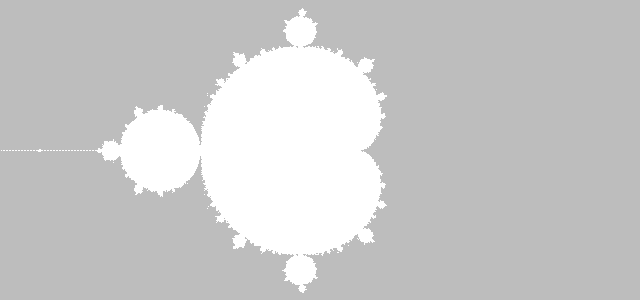
I remember a couple of scientists talking on ABC Radio National back in the 80’s. They were visiting Australia on a discussion tour. They had done studies of differing forms of divination for a year and had come to the conclusion that “tarot defies the law of probability” more than any other form of foretelling. Up until then I’d always wondered but had never had the keys to look for answers to the mystery of what I do. I undertook some basic study of quantum physics and read Gleick’s book on Chaos Theory, pondered, in awe, such things as the Mandelbrot Set and Fractal Geometry.
If we take into account the theory of the Big Bang then light (remembering that it’s a vast thing and the naked eye sees only a very small section), which is both particle and wave, occurred instantaneously throughout the universe. Matter, on the other hand, seems to be taking its time catching up, which is why our universe is said to be in a continuous state of expansion.
As nothing comes from nothing we were the Big Bang, albeit in a different state of vibration: both light and matter on an arrow-flight through conceptual evolution, however virtual. Now whether we consider our current selves as human or otherwise is really irrelevant; whatever we even contemplate our ancestors as having been is really irrelevant. What is most profound is our having been there, because if we hadn’t been there we wouldn’t be here now. The mere fact that our haemoglobin contains iron; that our insides slosh around in vast quantities of a fusion of hydrogen² and oxygen (and that hydrogen is what fuels stars) is fact. That our bodies follow a seemingly adequate set of parameters and reproduction indicates that they remember having been around forever … and that surely after several billion we’ve experienced most everything in one manner or another.
When a person shuffles my tarot cards they are actually sorting them into order. Because everything has been experienced that person doesn’t need to look at the images, like a very proficient pianist does not have to look at where their fingers are going (and in some cases to look would be to stop the music) because the music is in them. I interpret what the person is telling me because quite often when you’re involved in your life you lack objectivity. This is where the strange part comes in. And I’ve wondered about this all my life: is it a case of the chicken or the egg?
Collapsing the Wave: Thought to Speech
Have you ever heard it said that to name the thing is to empower the thing? That to speak it will either
a.) prevent a thing from happening, or else
b.) if you speak a thing you will cause it to happen (hence touch wood)?
Well I have.
Not only is it the basis for spell casting it is also founded on an interesting theory put forward by Dr Darryl Reanney in his book The Music of the Mind: that thought is like light and travels at the same speed and that speaking collapses the wave giving it a semblance of matter. Once spoken, never unspoken. Once spoken, the thought becomes interwoven with the fabric of our atmosphere as a frequency (please see Part One as a reference to babble) and can interfere with material reality.
Consequently, once I say aloud what I see or experience in tarot it enters into time. Still as an energy (like light) that the individual will walk into sooner or later, it will be recognised as it happens. Therefore, retrospectively, as the present moment is already the past it has already happened once spoken.
It’s the same with causing events to occur by way of the use of verbal magic. One can enter a spell into an average conversation and probably no one else will ever know. It all depends on what is said and how it is said but the reality is that I know I’m creating a loop: NOW®THEN®NOW. It all depends on how we understand progression. When we really throw away the illusion of linear time all things are valid, it’s merely a matter of when.
To achieve a conscious transition from the fate of linear time one simply needs to look at life, the seasons, the natural configuration of existence: it either spirals, cycles or unfolds. When and why did the line become such a god?
Thought into Matter
Propaganda is one of the more potent influencers of contemporary western culture. Media and the advertising industries are the current dispensers of doctrines of acceptability. Throughout the centuries people have been told what they should or should not do and are threatened with the inventions of damnation, starvation or torture for bucking the rules. These inventions are projections of consciousness. I know this could sound trite but it is people who make tables, and tables began in the minds of their inventors. Therefore, to think a thing is to trigger an act of creation when the thought is manifest into a material reality.
The future is the product of all that precedes it – it is a concept. It is therefore really important that we participate in the art of creating events yet to come into existence through our current actions and awareness. This requires conscious choices in every situation, no matter what our lot in life. It requires conscious responses to sensory input, specifically in relation to words, realising that Logos is as easily manipulated as a puppet.
Part 2
DESPAIR
Practical ideas towards healing
When, either personally or collectively, the illusion of either abandonment or disconnection (sometimes both) mental illness manifests and expresses itself in a tapestry of dysfunction. This disease is despair and a necessary step in the eradication of despair, is to first recognise that it is present, either in yourself, your family, your peers, your community, the current zeitgeist or the demands of a society. To do this you monitor your attitude and outlook on everything for a set number of weeks/months. You will, of course, be affected by news and advertising which, more often than not depict the world (in the former) in a disadvantaged state and (in the latter) what you will need to own or to look like to be on the winning side. There is no point blinkering oneself throughout this training. It is also important to keep eyes wide, wide open; to learn as much as one can about the soul-illness afflicting our mutual species. It seems to present itself in several ways:
Apathy. Constant assault from myriad media sources can trigger a form of apathy whereby people can watch absolutely horrific scenes of barbarity and brutality that eventually, seemingly bounce off the psyche … but do they? How can they? What actually happens is more insidious: acceptance that these behaviours are validated by their continuum. The training you undertake in ridding yourself of despair is all about seeing clearly what is happening but realising that you are not a participant in the process.
Accumulation (or, when is enough, enough?) The propaganda of advertising is not about you benefiting from a product, remember that, rather it is about a chain of profit that has its own best interest at heart. That chain of profit includes people who produce nothing but who benefit enormously from those who do. And by creating fear. Finding a level of contentment with your possessions and consciously realising that you need no more is a powerful thing. It allows you the security of simplicity and it means you no longer feed the beast. To purchase your goods directly from the grower or the manufacturer means that you are honouring their work, feeding their families and denying improper investment used for such things as war, environmental rape, the lining of the pockets of the greedy and any of an incalculably vast arsenal of destructive research and development (including the still-prevalent use of vivisection).
Debt. Have you heard of the term usury? I realise that it is considered as the ‘illegal’ charging of excessive interest on loans but who is it that decides what is excessive? Is ‘a profit of $2.192 billion…’ in one year excessive? Is: “The Reserve Bank found the big four banks enjoy an implicit government subsidy worth up to $4 billion dollars a year,” said Mr Oquist.[5] This amount of money is SPARE MONEY. It will be used for investment. Do you know where this money will be invested? Do you know how this profit was accrued?
Every time you take out a loan, or purchase using credit, you are indebting, even enslaving, yourself to others. In the current climate of company CEO’s claiming bonuses in the millions of dollars you might want to ask yourself: How do I fare? When will be your next holiday? What is your quality of life like? I realise that I’m not necessarily talking about issues of which you are unaware but, so far, have I managed to get you thinking?
(Please note that some of the following topics will overlap each other.)
Relationships. Communicate without fear. Communicate without the need to manipulate. Respect silence when there is nothing to say. Whether we are talking about an intimate relationship, the relationship between family, between friends, between associates – the way to understand relationships, and not ‘lose’ yourself somewhere in these relationships, is to realise three things:
There is always going to be a pecking order within any relationship. This is not a power, or a power-over, phenomenon but a biological one. It cannot be controlled, and neither can the conflict that can, and invariably will, arise because of it. Therefore, understanding it is your first line of least resistance. No relationship is permanent and no relationship will remain fixed to any idea any of us may consider. False relationships are those based on power over others.
The Pecking Order
Every species of animal has one. The problem for us, as an animal species, generally, is that we don’t remember that we are one and we have been brainwashed through both the entertainment industry and religions of the idealisation of love. Many in intimate relationships find themselves in the dominant/submissive role. This always leads to conflict. When sexually active people mark each other with their scents (in effect: marking their territory) and someone else enters into the picture there willbe conflict unless the couple band together, like a wolf-pair, to attain a specific outcome (scenario irrelevant). In the case of a couple without children there is likely to be little conflict unless outsiders attempt to lay a scent. In the case of a couple with children? Well, here’s the reason for a couple of millennia of discord or oppression. In most other animal species the breeding female is always the dominant member of the pack, herd, barnyard and the males will always fight for her favours, therefore establishing their own pecking order. This is not our history. The male of our species has been placed in an unnatural state of dominance (and look at the mess we’re in). Currently the western world is undergoing a crisis of sexuality (specifically in heterosexual society) because, again taking animal behaviour into account, the majority of species do not take their sex lying on their backs. The flipping of an animal onto its back is a threat. In another powerful turn, same sex relationships and gender variations alter the perspective of what, even fifty years ago, would have been predictable in sexual relationships.
Suggested solutions to dysfunctional relationships
Share your living-space with several people, setting clear boundaries of mutual responsibility and gain. If assisting good friends or family to move into a new dwelling be certain to lay your scent on the dwelling by either cleaning, helping to place objects and furniture, cooking a meal for them using their appliances. This will ascertain you both feel, and are, welcome whenever you return. Respect each others’ needs for independence and spontaneity, do not lean or rely on each other, rather be together for the sake of simply that.
Recognise the pecking order that is natural between you, and your near associates, but do not allow it to manipulate or over-ride the uniqueness of each individual involved. Communicate freely (and that does not imply talking a lot) but do not invade another’s need for solitude or silence when that need is obvious
Impermanence
This is a very important ideal to keep in mind. I am not implying that all relationships will cease to be, rather they will definitely change over time as either/any of you explore and learn new things. You will find yourself at a disadvantage in any relationship should you place too much emphasis on that relationship to the detriment of your own journey. Many relationships do have a life-span and attempting to hold onto them when they cease to be relevant to either/any party involved is kind of like not burying or performing an appropriate death-rite with a corpse: sooner or later the thing will become repugnant. Quite often the severance process at the completion of a relationship is painful. So be it. Mourning is a natural way of dealing with letting go. Respect of both the self, and the process of change, is how one transforms through change.
False Relationships
Our culture is full of these. To avoid them, simply don’t do them. We encounter these at all levels of society – governments, business, family, institutional religion, within many education systems, socially. These superficial hierarchies are established for the purposes of control or greed (perhaps both). In an ideal world there is a need for leadership but that leadership ought to be based on the transparency, wisdom and proven adroitness of an individual. On their consistency. In an ideal society those leaders are not better than anyone else but are clear on the responsibilities based on honour and integrity. Leaders are good leaders when they don’t need to lead, and they recognise that they are merely good at what they do and are reliable within the expertise of that leadership.
Parents quite often demand that their children conform to authority that is not gained through example but through force (sometimes physical, usually psychological), as do many institutionalised educators, as do politicians and bosses.
Observation, on your part, of the behaviour and body-language of others will allow you to understand any situation and to either extricate yourself from it or mould your behaviour (not necessarily your true self) to fit the circumstances.
Death
Despair often walks with the person who has been taught to fear death. Through consciously realising the organic nature of death (and that everything does it, therefore it is natural), and deciding to live your life gloriously, death can be recognised for what it is – a breaking down of organic matter into that which it is forever becoming: something else.
Religions and New Age movements place an inordinate focus on retaining one’s individuality (as it is understood) after body-death and there are, therefore, a plethora of ideologies and theories concerning an after-life. I ask you to contemplate: when is there no life? What constitutes no life? When is there not life? Is it necessary to believe in an after-life as distinct from life? Do we know all there is to know? There is nothing ‘after’ life because life is perpetual; eternal. And, besides, it’s not like body-death is something anyone really ought to worry about because it’s going to happen sooner or later. In the meantime, what about the quality of living?
A Lack of Knowledge Concerning Our Own Bodies
When our health or well-being is taken out of our hands; when we do not know sufficiently about our own bodies to ascertain their functions; when we accept, blindly, the authority of others over our own, we allow the demon of despair to have itself a party.
Change the situation.
I was once told by a doctor whom I was teaching about fitness, that throughout the entirety of his medicinal training he only spent somewhere around forty hours learning about nutrition. Due to my own studies and research I was able to advise my own son, who had been diagnosed with “killer cholesterol” and given a prescription for medication, on a fitness programme and a nutritional regime that both he and his girlfriend could enjoy. It took him three weeks to reduce his cholesterol to healthy levels. He has since continued his exploration of such things as triglycerides, good/bad fats, protein/carbohydrate affects upon the body and has also rid himself of a ten year high blood-pressure problem (bearing in mind he was a young man).
Death is an integral facet of good health. Without sufficient decaying matter—compost—the earth’s ability to sustain and grow food is diminished, as are the food’s nutritional elements when they are consumed. Growing one’s own food is an unsurpassed act of creativity and as Frank Herbert said in his unpublished notes “A requirement of creativity is that it contributes to change. Creativity keeps the creator alive.’”
Mulengro
The spelling mulengro is a shortening of the form mulengero. This shortened form is used quite commonly in some varieties of Romani < mulhengero mulo (fog ghost) < Mulengero Di (All Souls Day) < mulo (dead) [these terminology are from the Burganland Romani dialect]
Mulengro is like a disease passed from one person to another through the use of seven dysfunctional manipulations: envy, greed, guilt, deceit, denial, expectation and assumption. Each time an individual seeks to entice, control, coerce or otherwise warp seeming facts to suit an agenda they will perpetuate one or more of these. The only way to prevent despair from overwhelming our well-being is to cease allowing Mulengro into our lives. I’ve done it; several of my students have done it; most of my friends have stopped it.
The outcome of being infected by Mulengro is always resentment, rejection and blame and, needless to say, despair. The carrier of this disease will always attempt to pass it on. I could write an entire book on the games that people play on both themselves and others in this fashion but I’m sure with contemplation and practice you can recognise Mulengro when it is present in your dealings with others.
Authority?
What a strange word. What connotations. The word has come to represent a pinnacle – the epitome of a powerful person. I rather detest the word and I would, perhaps, ask you to develop a healthy objectivity regarding this concept. The word authority is very different, in truth, to a master (such as a master carpenter, a master of the sword, a master chef) because a person who has mastered a skill is a practitioner whereas, in many instances, an authority is someone with an opinion who confers with other people with opinions and who, therefore, could be considered to be educated in opinions. Of course I’m generalising, but it’s worth your consideration as quite often those who consider themselves authorities do not condone having that authority questioned and that is, and has been, despotism or tyranny. Whether the presumed authority is a parent, the president of a company or country, an educator, a five-star general, or a pope, it is the responsibility of a truthful person or society to consider the individual, or the institution, open to fallibility.
I once sat on the loo of a friend’s house in Victoria pondering the poster he had on the back of the door. The image on the poster was of a skeleton in a bathtub in the bathroom of a hotel that is discovered in the far distant future by a team of archaeologists. They document the sarcophagus (the bathtub), the roll of paper used to send messages to the gods via an aqueduct (toilet paper and flush-toilet), mirror used for divination, various holy objects (like razor, toothbrush etc) kept on the altar, the obvious sacredness of water (realised, of course, from the profusion of taps), the quirky plastic crown worn by the king or priest of this temple (the shower-cap). On and on went the description. I realised that no one could truly understand the past from the stand-point of the present and that all such sciences employ educated guesswork.
When I see a documentary on ancient people depicting them bent-over, ugly, hairy primates I tend to cringe as nothing in life is ungainly in its natural habitat so why depict humanity, alone, as having been so? And primitive is merely deemed as derogatory in comparison to us now. To take upon oneself the responsibility of informed questioning ensures that authority does not take upon itself the liberty of ‘better-than’ – it allows for possibilities, it allows for alternatives, it allows for error and it ensures that the authority remains accountable.
Religion
The Jesus Myth
Pope Leo X, who reigned 1513-21, once said: “It has served us well, this myth of Christ.” By this he meant that over the centuries, the Vatican had managed to acquire enormous wealth and power in the name of a figure called Jesus Christ. In the twentieth century, the man most responsible for making the Vatican a financial powerhouse was its investment manager, Bernardino Nogara. Speaking of him, Cardinal Spellman of New York once said “Next to Jesus Christ, the best thing that ever happened to the Catholic Church is Bernardino Nogara.” Anticipating that Europe was heading for war, Nogara invested heavily in armaments factories, buying several of them outright. This allowed the Vatican to reap huge profits when Mussolini invaded Abyssinia in 1935 and in World War II later.
Religious Fundamentalism, Dogma and Bigotry
It is drummed into children in war-torn countries, brainwashing them into hating one another without knowing why. It is the arrogant racist who believes in an imperialist, white supremacy that presumes anything can be bought. It is in the neo-Nazi and the Ku Klux Klan. Fundamentalism is in the office worker next to you who feels her faith is superior to yours and that you will be damned for your viewpoint and your sexual activity and she, to a place thought of as paradise. Fundamentalism is the reason people mail anthrax to abortion clinics because they don’t believe a woman should have a right to choose. Fundamentalism is the man who bullies, beats or represses his wife because he believes women are inferior – the source of all wickedness because of some Middle Eastern myth from life only knows how long ago – and passes on seeds of tyranny to his children. Fundamentalism is the people who mock same-sex love; people who shun unwed mothers, the poor, and those infected with HIV-AIDS calling such a terrible illness “the wrath of God”. It is people who smile politely to those of another race in public, but condemn them in private purely because of the colour of their skin or their religion. Religious fundamentalism; religious laws, rules, arrogance, moral condemnations.
A very good way of controlling people, don’t you think? Divide and rule? A future where wonder is revered and the wildness and the beauty of life is honoured, where such terms as man conquers…, in the battle to control… and in the war against… are no longer used to discuss natural phenomenon like mountains, space, death – actually, to not use these terminologies for anything.
Religions? What is valid about them? Whom do they serve? Why do a vast percentage of humans insist on bowing to seemingly omnipotent and, to be honest, terrifying deities that have no connection with the rest of nature unless he uses it to wreak havoc on his enemies, or prayed to, to stop hurricanes, earthquakes, volcanic eruptions, oil spills, the leaking of Fukushima nuclear plant, the uselessness of future antibiotics. So much for omnipotence.
Religions demand worship. They demand divisions and employ dualisms like good and evil, us and them, sacred or profane. Us and them. Why? Religion and the words worship, faith, belief all to go together. Inherent within these words is possibility of doubt.
Part 3
The Power of One
Please don’t think that because you are one person you cannot have a potent and intense affect on the future. My grandmother started me thinking about things mystical and magical when I was just 11 years old. She’d never taught her stuff to anyone before me and she never taught anyone else after me. I’ve ended up teaching thousands of people throughout my lifetime and even more thousands whom I’ve never met have read the books I’ve written. I didn’t start out thinking that was what was going to happen and ultimately it doesn’t matter to me because I’m merely doing what I’m doing.
There is nothing without consequences and everything that you do will have them. If none of us change how we communicate between ourselves and our world, then we’re in an avalanche of trouble. I remember thinking, one time, on the eve of a rally on human rights, So what? It doesn’t matter if I don’t attend, what’s one person less? Of course it was just a fleeting thought. I knew I’d go because if I didn’t and nobody else did there would be no hope.
One becomes two, two become ten, ten become ten thousand … and apartheid falls. Ten thousand become one million, and one million becomes humanity’s next step to change.
Conclusion
Silence.
Silence is, without doubt, the most important form of communication. In silence we can think. With silence we can dare to explore the thoughts deeply buried within the caves beneath the tundra that may hold answers like the truth in a situation of falsehood. Through silence we can also hear other things so vitally important like wind and rain and birdsong. Within silence is heard the voices of the spirits of place, the warnings of our ancestors and the stories as yet unsung.
I am forgotten until you remember me.
I am the living root; the forever Tree –
I await beneath the senses for the soul who truly listens with an ear to hear my mystery … and in the song of such a one I am remembered; and remembering will set the sacred free
to walk through dreams that can rebuild the ancient trackways,
to awaken memories of fires on the hills,
to call the faidh and the ceoltoiri to attend me
As I plant the living legends in the places of the deep,
where the forgotten ones still sleep
of the forest of profusion of the ever-living Tree.
I am the guardian of the Gate – I am not found in any book already written, already printed, already bound
but in the spaces yet to be heard;
in the mystery of the yet-to-be-written word.
Ancient Now. Alive. Wilderness. Free.
Prepare a place for me – a face for me.
Deny me not – I am the legend of the vine
And I am yours, beloved, you who hear me,
And in an act that holds to nothing – we entwine.
The Feast of Flesh and Spirit (excerpt)
Ly de Angeles, 2003
Endnotes
[1] Vocation: a calling [<L vocatio, -onis <vocatus, pp. of vocare to call]. I mention this so that it is understood that we are talking about sound again/harmonics again and not simply employment or career.
[2] Talent is one’s natural ability to shine in an area of expertise particularly rather than generally. It is something one is born with that can be enhanced with experience.
[3] Though electromagnetic waves exist in a vast range of wavelengths, our eyes are sensitive to only a very narrow band. Since this narrow band of wavelengths is the means by which humans see, we refer to it as the visible light spectrum. Normally when we use the term light, we are referring to a type of electromagnetic wave which stimulates the retina of our eyes. In this sense, we are referring to visible light, a small spectrum of the enormous range of frequencies of electromagnetic radiation.
[4] P. Machamer (ed.), The Cambridge Companion to Galileo, Cambridge Uni Press, UK, 1998, pp. 64-65
5http://www.news.com.au/finance/economy/australian-economy/australian-banks-top-global-list-as-labor-persists-in-demands-for-a-royal-commission/news-story/aefa72c371555ced47804f9604c25c7c
Bibliography
Beaulieu, John, Music and Sound in the Healing Arts, Station Hill Press, 1995
Braden, G., Awakening To Zero Point (revised edition), Radio Bookstore Press, 1997
Gleick, J., Chaos: Making a New Science, Heinemann, London, 1988
Jenny, Hans, Cymatics, (Macromedia, Newmarket, NH, USA, re-printed 2001)
Quinn, Daniel. Ishmael, Bantam Books, 1995
Reanney, Darrel., Music of the Mind, Hill of Content, Australia, 1994
Saul, John Ralston, Unconscious Civilization, Barnes & Noble, Free Press, 1999
[1] Vocation: a calling [<L vocatio, -onis <vocatus, pp. of vocare to call]. I mention this so that it is understood that we are talking about sound again/harmonics again and not simply employment or career.
[1] Talent is one’s natural ability to shine in an area of expertise particularly rather than generally. It is something one is born with that can be enhanced with experience.
[1] Though electromagnetic waves exist in a vast range of wavelengths, our eyes are sensitive to only a very narrow band. Since this narrow band of wavelengths is the means by which humans see, we refer to it as the visible light spectrum. Normally when we use the term light, we are referring to a type of electromagnetic wave which stimulates the retina of our eyes. In this sense, we are referring to visible light, a small spectrum of the enormous range of frequencies of electromagnetic radiation.
[1] P. Machamer (ed.), The Cambridge Companion to Galileo, Cambridge Uni Press, UK, 1998, pp. 64-65
5http://www.news.com.au/finance/economy/australian-economy/australian-banks-top-global-list-as-labor-persists-in-demands-for-a-royal-commission/news-story/aefa72c371555ced47804f9604c25c7c
Bibliography
Beaulieu, John, Music and Sound in the Healing Arts, Station Hill Press, 1995
Braden, G., Awakening To Zero Point (revised edition), Radio Bookstore Press, 1997
Gleick, J., Chaos: Making a New Science, Heinemann, London, 1988
Jenny, Hans, Cymatics, (Macromedia, Newmarket, NH, USA, re-printed 2001)
Quinn, Daniel. Ishmael, Bantam Books, 1995
Reanney, Darrel., Music of the Mind, Hill of Content, Australia, 1994
Saul, John Ralston, Unconscious Civilization, Barnes & Noble, Free Press, 1999
AND WHAT IT ISN’T

WHO AND WHAT WE REALLY ARE
I have unlocked the stories in my bones. Memories of ancient primordial forests in which I hunted, making love beside a vast still lake. Remembering that my dead mother’s skin still lies there, remembering running silently between towering spruce trees in the snow, following the reindeer along deep ancestral tracks. My father was born on the pelts before the fire pit in a house made of earth, his mother and aunties chanting birthing spells low in their throats, and the small wide eyed children of the horse keeping vigil until the heavily tattooed old woman bites the cord. His child is me. A thousand generations ago you and I were there. Nothing has gone. Life has changed and many have suffered an unbearable isolation because no one has reminded us of who else we are other than beyond the current skins we wear. A walking man explained the Celtic word hiraeth to me as homesickness, a longing, deep and inexplicable because we don’t know what home is. The suffering this causes. Dispossession is in our marrow and that fear, beneath the surface we present to the world, of lovelessness and plastic and asphalt, crowding us into a corner from which we cannot escape.
Initiation is a mapped and charted experience that many people do not understand or recognize when the experience is not on their terms. You will be woken up. When wolf mother takes us in her jaws and pulls us into the myth we must realise we are helpless. Myth is not fallacy. Myth is as real as the skin that keeps our rawness clothed. Joseph Campbell, in Hero with a Thousand Faces, explains initiation as firstly a Threshold. We die to who we have been. And yes, always tragically. We cross into the Liminal World and become lost. This could last a lifetime if we lack the necessary insight to realise what is happening. We need to be on the lookout then, as we travel the days and nights of desolation and confusion, for the signs of the Return. We must keep our ears pricked and our tails bushy. There must be a Return. Someone to know us. To be met and the purpose of this new life be revealed.
When we consciously recognize the place in which we currently live as the liminal world of not-life we may very well be ready to Return. We will know. We will meet the Gatekeeper. This could be someone already there or someone new. They will complement the true us. This is not like any other compliment. The person is recognized for the depth of them and how far they have climbed from that pit. Words will liberate the dark night of the soul. The Gatekeeper gives the keys to a new life. Do we have the guts to walk through? To accept the change with only courage? To leave that lost place, savage forest, mist of futility, cave of self-doubt and take the challenge of being raw, temporarily blind and furless?
No one can hold us should we choose to make this choice, to wear the next mask and to clothe ourselves in this new garment of self. We don’t have to cleave to the identity that we thought defined us. Life is art. Life wants experience through who we are and what we do. Wants the lone wolf to run with the pack.
My most recent initiation took nine years and I didn’t know until I reached the other side.
My birthday 2006. Five hours at the clinic in Tweed Heads while my daughter has an abortion. Arriving home to my eldest son waiting with a bunch of flowers. Them starting in on each other. Him calling her selfish for doing this on my birthday, her not defending herself, standing up to him because what he does not know is that she is bravely battling the comedown from a speed addiction. The conversation escalates to all-out screaming.
I tell them to both go away. There is no birthday. Then I sit on the chair by the kitchen window wondering what the fuck just happened. Absolutely convinced I am dead. Pointless. I don’t know how long I stay there barely breathing. I walk across the road towards the beach. Then I’m sitting in the gutter of the street parallel to the ocean. Unable to move. A stranger comes out of her house bringing cigarettes. She lights one for me. We sit in silence. She must know if not the facts, the feeling.
To take or give initiation at the hands of a person is one thing. Quite another when life is the initiator. Because something is wanted. But first skin is flayed from us, brains are burned to ashes, souls turned inside out and air blown into them to rid them of creases. Bones are ground to powder and this dust is sent, by wind and water, across the whole earth seeking a home to fertilise with memory. To remember a terrible and tragic beauty to drag into now.
Year after year I stripped away the seeming-knowledge I had accrued over a lifetime—as witch, as woman—hunting for the pristine pools of limey water that lie silent within bedrock. A mystery successfully hidden from culture by smug-mouthed old men. Hidden in plain sight but never taught. The delusion of isolation from relationships with other species: rock, tree, sky, everything. The realization that we do live in two places simultaneously: the crass, beautiful, brutal world seen through my eyes as human, and myth world where the stories are that of forest and stone fortress, and initiation understood as clearly as an honest sentence. Where tragedy and ecstasy make sense.
Witch people, like magicians and sorcerers, conjurers, druids and hoodoo hexers, like cunning women and cunning men, kadaicha, shaman, mundunugu, manitou, angakok, curandera, bruxa, enchanters and shape shifters are needed in this world. We are the stories not bound by dogma or preserved in aspic, displayed as relics in a museum. We cause disquiet. We make questions but may not have answers. We are the wildness and the frightening places. The cave entrance under the ice at the base of that crevasse. Blue handprints on the rock face imprinted with an ochre of confusion by people we cannot name and from a time we cannot confirm. One must belong. We are Once Upon a Timepeople. People of the reindeer. Volcano people. I know that air has feelings and that messages can be sent through the earth; that I can touch someone and their lives will be forever changed but that I am not responsible. I know the shape of that cloud is a conversation. That a forked stick can find water. That the ring around the moon warns of rain. What I might tell you can go straight to your gut or the throat, and yes that’s a metaphor, but you do feel anxious because even though we are seemingly separate I can look at you and you might squirm because you know I know you are lying and are so lonely; that anything you do will have consequences. Everything has consequences. Mirrors are all around us.
Mercea Eliade wrote that Initiation recapitulates the sacred history of the world. And through this recapitulation, the whole world is sanctified anew … can perceive the world as a sacred work, a creation of the Gods.[1]
The language that he uses that covers me with wasps. What Eliade wrote is in a dead and religious tongue steeped in Abrahmanic analogy.
Initiation is occult. Hidden. Unexpected. One comes to the Threshold, passes through, crosses over or drops down the rabbit hole into the Liminal Space where one is lost within mists of unfamiliarity because the only mirror we have is who we thought we were, confounded or temporarily mad. Finally, we meet a Guide, the Threshold Guardian and the Return. That return is only significant if the newly initiated individual is embraced into the pack, the culture, held in the arms as newborn flesh. Someone auspicious now drapes you in a garment with which to clothe your wise soul.
This is the deep world. The land of myth. Where we are also other animals and the voice of crow and walrus, both familiar and alien. Where we are torn apart and rewilded.
So now, at the other side of this fearful and fearless journey, I have become La Loba, the Bone Woman. I wear her skin, and my hair, once the colour of night is now white. What is the garment? Not an old language but an immortal one, hidden beneath those same old men’s prattles, their pomposity, dry and dusty with the verbiage of religion and class. Of schooling that does not educate but indoctrinates.
I’d written a book about witchcraft, published in the year 2000. Do I regret that? Not at all, but by locking the words onto the page I trapped brother wolf, manacled sister eagle, put the wild salmon in a pond and said, There. This is what you are and here is where you must abide. I closed an open system that should remain as unpredictable as weather.
I don’t know when the penny began to spin. A while before this initiation, that’s for sure. My coven converged at full moons, dressed in meticulously hand-sewn robes and talismanic ritual jewelery, lit candles and incense, placed athamé, wand, chalice, pentacle, the skulls of long-dead ravens, on an ancient wooden box I called an altar, cast the circle deosil, invoked the spirits of earth, air, fire and water, murmured the incantations to one goddess or another, to one god or another. And deep down I was now thinking I should not be doing this. Knowing in a very fearful silence that I was dressing the wild world in the garments of predictability.
Not long after that birthday and mere weeks before we were given notice to vacate our home of twelve years, I had a dream that gave me the clues I would only interpret, fully, almost a decade later. Early morning, the hazy light of dawn twilight, I approached an old, weary, shabby weatherboard house in the company of several others. We were there to clean. A gnarled, borer-holed, sadly grey plank barred our entrance, nailed like a warning across the front door. The sinewy old man made us wait. From the tool belt at his hip he took sandpaper, cloth and oil. He sat cross-legged on the grass and transformed that plank into beauty, mirroring the day. He nailed his plank friend atop the door and we entered. Come the reds and indigoes of early evening we had travelled all the way out the back and stood above a steep V-shaped valley, leading west to the last of the sun. The breathlessness of that place. Granite escarpments, shadowed and vast, trees high upon the cliff top black against the gloaming. Ravens calling sentinel for miles in all directions.
I stood beside a young woman with a bucket in her hand. She said, what happens if we leave? Do you think we’ll ever be able to find a way back? I, in my considered wisdom and certainty of experience, said, I’ll be the guinea pig, shall I?
Then night. I stood, weeping, on the derelict, deserted platform above a railway track, a young girl’s hand in mine. A station worker, with a broom and one of those long-handled scoops for rubbish on the ground, asked if he could help.
I can’t get back, I replied.
We actually moved to that house in my dream, with the escarpments and the sun setting in the cleavage of that valley to the west. But reality was fog surrounding trees in winter.
Then in 2007 I felt myself dissolving. I was no longer whole. Life made no sense, but I kept on reading tarot and the people kept coming. Many of them also broken.\
Was this what Eliade meant? Was the whole world in liminality? We were a year prior to that global financial crash, the illusion of money built on the same hollow mound as Vortigern’s doomed castle. Lots of broken people that year.
We think we’re the same person just going through travails. That we’ll wake up safe in a few days or weeks or months and the drama will have passed. We’ll be the person we were, hold the values we held previously and believe what we always believed.
Silly me, I still thought I was who I had been. As yet I had no level of insight. I thought the Byron Shire, where I had lived for twenty two years, was still my country.
In truth I had no home and experienced hiraeth, that dreadful longing, constantly.
In Melbourne in the winter of 2012 the fog triggered a memory. Fog thick and silent outside my daughter’s kitchen window. The day Samhain-like. Closing out everything. Reminding me of a lifetime ago. When my children were babies. When I was a child. When I still had all my teeth. I hid in a back room all day writing the since-deleted beginning to this memoir, knowing beyond doubt that home was no longer home. I could no longer pretend that I belonged anywhere. I needed fog, all the many shades of grey, bone-deep cold, architecture older than me. Its history and dereliction.
When I told friends I was leaving they asked why, perplexed at the thought. If I stay, I said, I will wither and fade and have bequeathed nothing of any current value. I will become a bent and invisible old woman.
The friend who was secretly a Guide said why don’t you teach Celtic studies at uni?
I didn’t understand.
I can’t, I explained. I’m really stupid. I’ve just pretended to be clever all these years.
Rubbish, he replied. You can start with a Masters if you want to. You need to meet my supervisor in Hobart.
I laughed but he wasn’t being funny. The fog thinned a little and I could sense the dapple of sunlight.
Later that year I took my twenty nine year old daughter to MONA [2] for her birthday. In Hobart I met that scholar. She gave me the keys to the Return.
The man I initiated thirty-four years ago is also a Time Hunter, one of his talents: genealogy. He asked for my biological records. What? More shredding of secret, long-held delusions of ancestral importance? Bus drivers and servants in the houses of gentry? But for me existentialism is always blended with mysticism and the curiosity to know the treasure at the heart of the Maze. I had new stories and a fledgling new language and guts.
So I allowed this goblin in.
The Time Hunter rescued the roots of my ancestral tree and, week after week he dropped names like nuggets of dull and lead-like information. These long-dead relatives all lived in the north of England. Albion. Generation after generation. I was busy elsewhere and the Time Hunter’s morsels were boring. What a brat I can be. Then he spoke a name. A spell.
Oh, he said, quizzically. They’re not all from Lancashire, Yorkshire and Lincolnshire. You have a Welsh ancestor after all. Caradoc ap Silures.
I must have looked ashen and the Time Hunter frowned.
I did have that strange feeling one gets when one is about to faint or the sensation of dreaming and was I really clothed?
I know that name like the back of my hand. My ancestor is also my hero two thousand years into the past. Those people that never moved were indigenous to that country. Priteni. Ancestral earth.
Born into a bigoted and sexist world, brought up as someone’s fabricated lie, living a lifetime with no family other than my children, their children and the people I adopted, the Time Hunter gave me a core reality. At the conclusion of the initiation he clothed me in a new skin. He handed me the keys to becoming La Loba and I am no longer lost.
Thanks to all who support my work

1 Rites and Symbols of Initiation, first edition, New York, NY Harper and Row, 1958
[2] Museum of Old and New Arts. Also the Druid Isle now Anglesea.
The ecology of remembered indigene
Sitka spruce! The seed must have blown in from the great plantation across the mountains. They were, as far as I could tell, the only trees on the reserve. They were, as far as I could tell, the only trees on the reserve, except for those clinging to the inaccessible slopes of the ravine. The white plague—or so I thought at the time—had destroyed the rest.
George Monbiot ~~ Feral
Before the Romans invade mountains and fertile valleys and shoreline habitats, I am here. I am Brigant, and the human Brigant children are sometimes called Carvette—the People of the Deer. My current positioning, on a nautical map, is Latitude: 54° 29’ 59.99” N, Longitude: -3° 14’ 60.00” W.
I am Cumbria, and although this is difficult to define, I will say that I am cousin to rivers, lochs and aft-shot off the western isles. I am the waters of what is called the Solway Firth just north of Carlisle, that bring us the stories of smelt, flap-footed seals, basking sharks, blue mussels and curlew; Mona—Ynish Mōn—is known in a modern, shallow, know-less-ness, as the Isle of Man, that Tacitus, buddy to the bitter politician Claudius, writes of as a land of druids. I am standing stones and the first forests of oak and rowan, spruce and grave-dappling yew.
And let’s not forget mo wee islands—named by the Norse—of Walney, Fowdray (Piel), Roa and Foulney, all laimrig-safe, for anchorage, amidst the terror of a beum-sléibhe from the west, on trade route currents, puffing out the main’sls of the big ships and bobbing insanity of the coracle and curragh, by ocean route twixt Éire, Breizh (Brittany) and, well, all lands traversable throughout the epoch known as the Bronze Age. Lands once also called Rheged.
Have I been fought over? Yes. Am I extant? Well, one woman is still here. One man. My children are here (or else otherwhere, by way of fate or tragedy). These grandchildren are living also, so how can I not be present, wherever governments, traders, invaders and deeply entrenched trauma has driven us? Despite over fifteen thousand oceanic miles between some arcane, vast, unpredictable dreamtime island, beneath the wide dark skies of Koodjal Koodjal Djooka and me, this ancestral home.
DROWNER WATER
The spirit who bideth by himself In the land of mist and snow, He loved the bird that loved the man Who shot him with his bow.
T.S. Coleridge ~~ The Ryme of the Ancient Mariner
I am keld and fen. Reed-singing marshland, and I am home to teal, and the Alban grandeur of the little egret, oyster catchers, barnacle geese; the eerie, seelie language—weerloo—of a night-calling curlew. Hence I am bogs and territories of peat, primordial, drowned plant-people cousins, once vast beyond comprehension, gracing earth from some glacial estimate of twelve thousand years deep. The end of a mythic and legendary ice age, or two. Or three. Or whatever.
I am Eden, river of the black fell moss, cousin of Swale, and Isurā, and the journey of salmon kin from spawn to demise. My dawn is high in the Wild Boar Fell and my night is Carlyle, 1,824 feet above the shores of our sister lands. I flow east, then north, receiving lore and fealty from the many becks that join me from along the vast mountain chain known, by some, as the Pennines. We skirt the verdancy of a forest whose name, now, is lost in the dead mouths of my ancestors, stolen by the English to be called Inglewood, in the eleven hundreds.
I froth and blinter, viridescent and storm-tossed, winter-dark and cloud-filled, past Long Meg and her Daughters, to eventually reunite with the sea, amidst the rime and bar’ber—the pirr – all around me. Beneath the lights of an Réalta Thuaidh, tossing a million years of clitter, gritstone and tuff, to and fro along ancient shores and estuaries that summon smugglers and survivors. Soothed by arctic freeze sometimes, sometimes doomed by hob-gob, often an endragoned danger, seldom by calm or fancy.
I am baari-river-stone-carved veins, brooks and burns coursing from Solway Firth in the west to Tràchd Romhra—the Firth of Forth—choking a bit on the abandoned shopping trolleys, condoms, little orange-tipped syringes, cigarette butts, discarded Slushy cups and, occasionally but regularly, the body parts of some bloated, drug-fucked, forgotten, abandoned, mutilated and murdered dead. Dùn Èideann (Edinburgh) with the grand fortress made all of grandfather stone leaning down towards me calling Take me, take me now! On this epic excursion from the Irish Sea, to the shock, and whale-mother-depths, that human people call Muir Lochlainn far to the north where the finnock swim.
I am heard, but not always seen (by the human eye), in the grimlins.
CLOUDLY STARRY SKY
Oh, we are hard to kill. Four thousand years into the long ago is the attributed when of our underearth-ness story but… what about now? Who are those who write about dúthchas (my human children) when most have forgotten the legends of ancestral treedom? Of the hunter and the hunted?
Yet we are dead. Are we? Or so it is written. So. I am confused, and I am confounded because beneath this mighty soil, within the secrets of the mountains and the magic and the mystery of the Northern Lights I am majestic still; enchanted, even, of the sídhe and the nurseries of the cladd. Within the weem, I nightmare, although awake. Roots engorged with life, beneath peat, the heather, the roarie-bummlers, still with sap a-plenty, and ready for man-looking forgetfulness. Waiting until… A thousand, thousand Svalbard globale frøhvelv barrows, of the Celtic human person kind, that nurture unborn forests and foraging memories, that will awaken, in some momentarily unrealized epoch, to the bull-moose trumpet or the wolf-pack howl. In another day, in another century, when liberated (oh, that incessant fear of starvation, of a poverty that forests never cause), by that not-forgotten piping of eagle bone flute, or scream of protest by sister vixen. For Mother to give birth, she needs relax her bothered and relentless rain, release the dormant to be living, instead.
We say, I remember you! as we cut the last lamb’s throat, kindly, holdingly, remembering that once a forest, always a forest, given just enough breathing room to seek the sky, no matter that the air is filled with the detritus of cotton factories and coal mines, and families driven to despair through the greed of some stranger in a bureaucracy somewhere, cloistered and bland, a fact hidden by the façade of whiskey and cocaine; to the violation and carelessness of the dùthchas by thanes, headline-grabbing prime ministers and media, not understanding (or on pretence of ignorance) the rightness of deep-veined ancestry, as though a paper decree holds more weight than a dolmen, a murder of ravens or an ancestral kinship system, remembered long before there were scratches on a page, trapping words into idioms and propaganda.
FIRE IN THE HEAD
These wings are the beauty of the poet’s soul. The songs, thus flying immortal from their mortal parent, are pursued by clamorous flights of censures, which swarm in far greater numbers, and threaten to devour them; but these last are not winged. At the end of a very short leap they fall plump down, and rot, having received from the souls out of which they came no beautiful wings. But the melodies of the poet ascend, and leap, and pierce into the deeps of infinite time.
Ralph Waldo Emerson ~~The Poet
And now I feel the need to sleep for a million years.
A human being, or so, might read this letter and think, What do you matter? What does it matter that you are what you are? And I am confounded that you is not I, or even we. As though, at some crossroads, people stopped singing and meeting. Stopped remembering. Forswore knowing me as family. The grief I experience at having these children’s backs turned away from this love is devastating. This tenderness of family, lost. This memory of elder lore seemingly vanquished.
Well, Voldemort, upstart of faux-wizardry that you hide behind, with your Apple smart watch and your Louis Vuitton running shoes, you cannot set your bedding down, up here. My scarped soul. My moss-breek. You will not be lound from me. No imlioc, no glisk, no fardon and no ystafell in which you can hide. That you choose to call a passage to within the earth, and a place of secrets where only they and I can hear and know, a grave (where no ancestor ever was buried) shows only that you believe some resurrection fiction, and not the mythos birth and death that is that, of seed, to stem, to leaf, to bud, to flower, to fruit. That you call worship, where there is no god but us, and I, and we.
What happens if you forget? If you are forgotten? Is there a reason for the idea of death? Are you so lonely you can’t understand our language? Our zwer? Don’t you remember we are knowe? That we are daal’mist? Lighty-dark? Geal-cauld and the plutsh of walking boots hollow-ringing in the dark, hushed, torchlit barrows of your ancestors, telling of Merlin of the Borders, and Mackerel and Morgan le Fey? Children’s stories hiding a deeper wisdom. Just in case?
I am not forgotten, Carvette; not so drookit I can’t feel the sun or raise my voice in sheepy-silver shine at all. I am no ink-drawn border on Google Maps: no England. No Scotland, Wales, Skye, Man, Ireland, Lewis, Harris, Mór, Ratharsair, Orkney, Scilly or Stornaway. These are names that are written to push me from your insides. As if you could. I am, that’s enough to say we are.
I AM FEY AND THAT’S NORMAL
As if the idea of glittery, painted, winged, diminutive inventions of an invader species could diminish us. Call us “fairies” as though we are not I, as though I am not the whole land, the entire sky, the everywhere who is river and underworld cave. Could warp us into a bit of no importance when, in fact I am, we are, Gentry. We are the Good Folk. I am sídhe and Rob Roy and Sterling. Calgacus, Culloden, Annie Lennox, the Monarch of the Glen and—once—elephants with long straight tusks. Black bears were all killed off to make silly hats for some inntrenger-appointed king, or queen (such pompous titling words, as though one person has more importance than another). I am carboniferous limestone formed about 340 million years gone. I am Pendle Hill. Sandstone and shale and gritstone moorlands. I am drumlins, oh, and I am Emily Bronte. I am cousin to the dyke swarm of the Isle of Mull, 56.4392° N, 6.0009° W, off the west coast of Alba. I am the ill-fated, possible vilified in some propaganda-driven, first century media condemnation: Cartimandua.
History is an opinion with an agenda. Its curse is that it is a story written, not spoken, that of men, of what is taken and who is harmed and who is better than everyone slaughtered, no matter the kindred species, no matter that the land burns because of it. History uses words as though they are flosh instead of a winterbourne, in the wonder and bafflement, and laughter and tripple of us.
I am, we are, here is…
DIVERGENT
I am here.
I was body-born as who I am now, in Australia. I was the firstborn and the only born human child of Celtic ness that salmon-leaps as far back as records are kept. Parents forgotten. Here for just a generation. Dead in some high-walled graveyard, or else ashes that are nourishment for controlled roses, with a hint of christianness to dishonour the fire in their blood.
Have I a right to be here? In this landscape? This person of ancient differences and extremes: long-befossilled desert and Uluru stone? No. I have never been granted permission. Not by the First Nation human people, not by emu people, not by a wedgetail eagle-person or barramundi clan. I am the people of so many Celtic countries I forget, just for a moment, how many.
Until the great white shark, the goanna, the king brown, the jumping jack ant colony, red dust, oceanic rip and giant old growth mountain ash say, Here, here, be here and sing to us of unknown or unremembered being, since Gondwana, child of soil and sun and star… I remain a changeling from the Seelie Court, left in a place in which I should not, really, thrive. For that I apologise with the whole of us.
NOW
I bring stories. I will offer them. That’s all I have. That’s who we are. But who we are is where we belong. And what, of that, we can bring to the gathering. Whether we tell of loch or ffrwd, of decimation or invasion.
Better that, than to merely say, Hi, my name is…
as though that is all.
……..as though that is all.
…
Thanks to all who support my work
REFERENCES
https://www.poetryfoundation.org/poets/gerard-manley-hopkins
https://www.poetryfoundation.org/poems/43997/the-rime-of-the-ancient-mariner-text-of-1834
https://www.monbiot.com/2013/05/24/feral-searching-for-enchantment-on-the-frontiers-of-rewilding
Firth of Forth: https://www.scottish-places.info/features/featurefirst1120.html
https://latitude.to/articles-by-country/gb/united-kingdom/1372/cumbria
http://www.noticenature.ie/files/enfo/factsheet/en/WL40%20Irish%20Sea%20Creatures.pdf
Carn No 153 August 2012_Issue No 138 October 2007.qxd
Traditional acknowledgment and introduction | Crossroads
Britain’s fabulous totem poles – Mike Pitts – Digging Deeper
What are the Celtic Languages?
Anglo-Scottish border – Wikipedia
River Eden, Cumbria – Wikipedia
Solway Firth | Living Seas North West
He sits at the bar. His cap is dirty, visor pointing back, as though to a conversation he can’t let go of. His hair is tucked behind his ears, pierced with blackthorn and briar. He seems drunk but isn’t. Drugged, but is he? He introduces himself. I’m Tommy, he says, It’s not my real name, and I could be crazy or a ghost, in case you was wonderin’.
I wasn’t, yet. He’s what? Maybe twenty? Looks are deceptive, though, unless we look with better eyes than just the ones we think see.
So the curse kicks in and I see him. Really see him
He has badgers nesting in the caves of his eyelids. Mackerel and seals, basking sharks, from the far North Sea, thrashing silver and deep wild water muscle, black within each iris. Albatross, and two Vs of returning snow geese are forging through storm-crazy dark and ominous cloud, thick with ice — sky wracked licorice custard — effortless, from his mind to his mouth. He speaks of magic and druid lore and slaughter, and of all the unborn baby birds that, he whispers finally, might not live beyond the shell.
His breath smells of the smoke of peat hearths, like a squalid, dangerous perfume. And kelp. And loam. Oh, and eagles pipe his name. And hares descend to the valleys of his hands to rest between the lines that tell of elder days and fathomless drownings.
I want to disbelieve him. That he should even be. I want to think him mad. Mortal. No guardian of any legendary grail should look so derelict and distant. So busted, but who am I to place him?
Dusk, seeping through the sigh escaping from his memories, is some place none of us should ever go. Somewhere between. I know that superstition. Like Oisín, returning on a moonlight horse, with hope that had rules he could not follow. Dust, that was. The loneliness of the forgotten. Its violatory emptiness.
My lake has run dry, he whispers.
Soil, like dried blood, or old loam, is under his fingernails, more lightless than the rooms where he hides the indignity of thrashings. Wild violets crack their arctic sod. Spring snow is still thick. It seeks sunlight that can’t come yet. He holds out his arms, soundless with forgiving.
Do you see me? he asks, disbelieving. Longing.
I hear you, I see you.
Then you belong, he whispers, and coaxes twinned swans from his deep pocket. Willing them their freedom. Some unrecognisable ensorcelment. They don’t go. Some willpowers belong to no one but ourselves, I suppose. They shelter around his neck and touch each other, beak to brow. Lovers from the long ago. Not leaving. Not agreeing to the wasteland. All he knows.
The Fisher King sips his beer. His lips attempt to open with a storytelling of queens and glittering mirrored halls, but they are glued, like swallows to an alley wall, and nothing but a kestrel, from the top of the mountain, sighs its wingspan along the swamp that is the bar, hunting nourishment that used to be in copse, in thicket, in covey. The woman behind it pours a shot of oblivion in amber, watching him, afraid because she doesn’t understand how she knows not who he is, but what. She turns her back. She doesn’t dare any other way. He leaves forgetting on the counter. A tip, sort of.
When he steps out into the terrifying night I follow, wanted or not. Ignored. Old roses and bloated lilies, flaccid, hectic, catastrophic with lost beauty and entertainment, are dashed to decay along gutters of earlier rain before dropping through the destiny of an iron grate. They remind him, and he does not want that. Fur rushes past, grey with old snow, mother wolf searching for cubs amongst the detritus of the city, him knowing she won’t find them.
I am broken, he says, rolling a cigarette but forgetting what it’s for. Acknowledging that I am his company for a while.
I have seen your palace, I say.
He stops.
It’s a tent, he explains. You didn’t see anything. Besides, it blew away.
Like hate, I say.
Like belief, he answers, unsmiling.
And the rooftops are lined with indigo shadows. Pigeons. Noticers of crime and couriers of war, because he is what he says he is, but he is drowning in air. They are here to witness. Crows, the druids of another violated island, rattle down to balance, ballerinas in mourning, on the power lines. I’m fleetingly reminded of a childhood that was someone else’s. Wishing it was what really happened and not what did.
I know, he says.
And paired Orcas ride the roiling surf that foam-flecks through his compassion. He has stars for footsteps, each soft with a long-ago burning.
I am dead I think, he whispers.
But I hear you. I see you.
As he shrugs, ivy twines a thousand unchainsawed forest giants. It has a right to be here because it always has been. It garments his shoulders with a mantle, a remembered warmth upon which the swans settle, a birdly dark green nest, unmade by effort. Dreams, like icicles in the heart of a midwinter’s eve, weep down his cheeks and holly, oak and graveyard yew, form a procession along the desolation of street tarmac, drinking from him, growing infant mountains from decay. He does this.
I know you, I say.
He touches the muscles of his chest, beneath the thickness of the coat that frays at the slightest frightening, with a hand corded with the gnarled roots of a Brú na Bóinne rowan tree that crowns this king, like early spring, with vivid verdigris, with the courting songs of foxes across the valley, with the sorcery of those thin slivered tattoos, like a lifeline of ten thousand years.
If I hold him will I kill him? Like a coward, I look down, instead. If I know him will they lock me away too? If I tell him that I will remember, and I forget?
Gotta go, he says.
It takes discipline for me to say nothing else. What if I forget?
There is one — he says, over his shoulder, as he begins his disappearance. I know he means a grail. He knows I know.
I am the Fisher King.
Did he just say that and I thought it was the mist soughing through iron bars? Me? Forget him? I beg the night, don’t let it be the other way around.
Thank you for supporting my work
FERAL: REWILDING LANGUAGE
“I was given the casket on the condition I disposed of it in the deepest, most secure underland site that I reached – a place from which it could never return. The second of the objects was an owl cut from a slice of whalebone. It is a talisman and what it connotes is magic. The minke whale from which the owl was taken had washed up dead on the shoreline of a Hebridean island.” Robert Macfarlane, UNDERLAND (p. 19)
INTRODUCTION
Disclaimer: the names and situation associated with the woman called Hecate are fictitious. Any resemblance to anyone living or dead is purely coincidental. The scenario, however, is based on a factual, similar event.
“I’m a witch,” said Hecate, smiling that smile I’ve seen countless times before. “I’ve read your book. It really helped me center myself after my divorce.”
“Which book?” I suck on my coffee, a bit blissed at the autumn sun on the back of my neck, despite the intuitive hackles.
She’s confused, as though I’d just devoured a baby in front of her. “Witchcraft Theory and Practice. Um…”
“You didn’t know I’ve written more?”
“Ah, no. It’s great, by the way!”
I’ve got a workshop called FERAL, on the rewilding of language, beginning again over the coming weekend. I don’t want strangers hanging about my house. Have I had death threats in the past? Yes. I’m still alive though. Obviously. I prefer to meet those I don’t already know in a café downtown. Suss ‘em out, inoffensively, obviously.
“No, it’s not,” I respond, kindly. “I signed the contracts with the publisher, for that book, in 1998.”
“Classic!”
We’re getting on nicely, so far. Am I about to fuck that up? Of course. “So, you’re Greek?”
She’s forty nine. I remember being forty nine. All my kids grown and gone their own ways. Me thinking I knew everything. Silly stuff like that. Her hair is dyed a precocious and eye wateringly fluorescent pink, and a really lovely septum piercing dangles above her top lip. She keeps fiddling with it. She’s as wildly Bohemian as any goth on the streets of Melbourne and I’m mightily respectful, if not a bit wary. She wears a rustic, heavily tarnished silver pentagram, and her fingernails, while fake, are killer-black and as close to talons as a nail parlor can get ‘em. “Hecate…” I continue. “Myth and legend and all that. You don’t look Greek.”
“I’m not. I’m Australian. Hecate is my witch name.”
“I’m dreadfully sorry about that book, then.”
PART 1 – WHAT’S IN A NAME?
NAMING IS TREACHEROUS
It’s time we had this conversation. And Hecate, the woman sitting with me, is a powerful case in point. She is not who she thinks she is, and I am about to become involved in her true-life mystery, and a magic that is both real and tactile. But first you and I have some talking to do.
Witchcraft, as an action. Witchcraft is something one does. Witchcraft is often equated with wicca, and wicca is referred to with an upper-case W, to indicate its importance as an entity in the modern vernacular, in the illusionary, non-place, called the West (west of what, I am unsure. It’s a rather silly construct) and is, currently considered a valid religion.
WICCA
But wicca, the religion, is not witchcraft, and does not, of itself, practice witchcraft. It is a ritualized, quite new, devotional practice that I was involved with for many decades but that, ultimately, being a savage and a pedant and an anarchist, I came to understand as a magnificent, utterly well-intentioned form of religion where dualisms and invocations take the place of hopes and prayers.
Douglas Ezzy’s book [1] confirms Hume’s hopes for the future. His volume, published six years later, is essentially a collection of testimonies: fifteen chapters in which sixteen practicing pagans (including Ezzy himself) speak of how the practice of paganism has affected their lives. The tone is warm and conversational, and the pagans emerge as charming and interesting people, ranging from youth to late middle-age. Common themes include the feeling that the Christianity of their upbringing did not fit their view of the world; the electric experience of working ritual alone and in a group; a concern with both feminism and the environment; and the celebration of human life, from birth to sex to death. Source.
I relish ceremony: candles, the cough-inducing interference of commercial incense, the need for an altar, upraised hands, robes, talismanic jewelry and charms, pentacles and salt or chalk circles, or else those drawn with a stick, a staff, a wand, a gesture (or a dagger… we’ll get to that) in sand or soil; on the lounge room carpet or cellar dust. The list is long, and many are the commercial outlets that will provide us what we seem to need to enable us to be well-prepared to function within the ideal parameters of this chosen way. To sell us stuff that, according to the books, is appropriate for witches. To authorise meaning. Because, Hecate forbid, to work a ritual in jeans, socks and a woolly jumper is just plain, well, plain.
SPELLS PART 1
People often write to me asking for a spell for this-or-that. Some claim to be cursed. Some ask for the cure for fear, or as a way to get rid of someone, or to find love. To attract a job or cause world peace. Do they work? See SPELLS PART 2, as I’m about to get distracted by the other side and its use of word magic (or, in the case of the Synod of Whitby, “a hostile sword” quote is from Bede) to utterly change the course of human thought.
Thus…
“What must it be, then, to bear the manifold tortures of hell forever? Forever! For all eternity! Not for a year or an age but forever. Try to imagine the awful meaning of this. You have often seen the sand on the seashore. How fine are its tiny grains! And imagine that at the end of every million years a little bird came to that mountain and carried away in its beak a tiny grain of that sand. How many millions upon millions of centuries would pass before that bird had carried away even a square foot of that mountain, how many eons upon eons of ages before it had carried away all.” JAMES JOYCE, on hell: Source.
NEVER BOAST, NEVER THREATEN
I guess witchcraft has its perks because at least there’s no threat involved. To anyone or anything. Despite the bad rap. But hell? It took Zarathustra to invent that and, a millennia or so later, zealots of the cult of the dead god to use it to threaten small children, sensual women, anyone with an alt-sexuality that’s anything not bogun, Trump oppositionists, child-sellers &/or dying soldiers.
This is not it. Where is the wisdom in any of it? And if there is none—almost a need to coerce and prove oneself alternatively worthy—why is the practice (or the idea) still adhered to, even after a hundred years of failed propaganda and, also, failed claims of authenticity? Like christianity, even buddhism, that offers the adherent an afterlife of vague cloud-and-right-hand-of-godness, terror—that mountain-pecking-birdiness, that is hell—or some flight into the body of a newborn someone or something.
But what has this got to do with witchcraft? And when did the word become a being thing instead of a doing thing? Have I been down the road of claiming? Yes. Did I know I’d bought into a cult, like any of the above? No. Did it gain me notoriety? Yes, but mainly in the minds of people who’ve never met me. Who are looking for a mirror within in which to see themselves. I understand that. Because there is a ‘ness’. A ‘something’, that implies that witchcraft is witchcraft.
But “a witch?” Houston, we have a problem (and yes, I know that’s a meme) or, in this case, Hecate we have a problem. Love and kisses xoxoxox.
SECTARIANISM, FEAR AND SPLINTER CONFORMITY
BACKSTORY
The early era of when a spotlight was actually claimed by an individual, rather than media, or theocratically-imposed rhetoric was in the latter part of the 1960s. Prior to its romp towards acceptability, in the form of Wicca, witchcraft was not even considered a something, outside of the mind of men, religion, the church, particularly peeved women, pulp fiction and B-Grade movies.
Witchcraft has about it, in populist consciousness, a dirty little bitter woman-face of dumbness and hysterical, disease inducing scandal. The foul and uneducated scowls of old women, with crooked backs and single eyes, living deep in forests, eating children who have become lost, or else, if in positions of prominence, within a highly christianised and suspect society, the secret queen of the castle dungeons, holding center stage, naked or slightly-so, albeit grandly draped, in a position of power, endowed by the attending acolytes and adherents, who wantonly lust after her alter-prone flesh-and-blood body whose spread legs temporarily encase whichever man is considered sufficiently well-represented within the court of kings, the crimson choir cassock of a papal cardinal, or the top hatted, mustached and monocle’d among the monied 1%, the aristocratic, the nobled or merchant-membered of a popular East India Trading Company equivalent (in the twenty first century) like BHP, Goldman Sachs or the Epsteinian uberclass.
These images, and fetish ideologues, were food for the press and the McDonalds-minded. Or else, particularly in the new diadem of defamation, Disney.
TACITUS, BOOK XIV, states – 30: On the beach stood the adverse array, a serried mass of arms and men, with women flitting between the ranks. In the style of Furies, in robes of deathly black and with dishevelled hair, they brandished their torches; while a circle of Druids, lifting their hands to heaven and showering imprecations, struck the troops with such an awe at the extraordinary spectacle that, as though their limbs were paralysed, they exposed their bodies to wounds without an attempt at movement. Then, reassured by their general, and inciting each other never to flinch before a band of females and fanatics, they charged behind the standards, cut down all who met them, and enveloped the enemy in his own flames. The next step was to install a garrison among the conquered population, and to demolish the groves consecrated to their savage cults: for they considered it a duty to consult their deities by means of human entrails. — While he was thus occupied, the sudden revolt of the province was announced to Suetonius.
It was from the voices and pens, of the supposedly, recently vindicated, that a hypothetical modern witchcraft spat I am here, and I will claim a tax break.
Without going too deeply into the repeals, by the British Commonwealth, of a law passed in 1735 and called The Witchcraft Act, that changed (slightly) its veil of godliness in 1951 to become the Fraudulent Mediums Act, these mothballed condemnations allowed for the emergence, into a public domain, of Gerald Gardner, a bloke sprung from the cabals of nineteenth century elitism—well-traveled to places considered the antithesis of an entrenched and self-certain christianity, such as Ceylon, Malaya and Cypress—and a family made rich by the timber trade, to become a member of a Rosicrucian order (circa 1930), practicing—or so I spae—out of Christchurch (in Dartmoor, not the New Zealand one), the territory of the invader/colonizer Saxons, who referred to the place as Tweoxneam, and that was stolen or misappropriated from an hypothesized indigenous Celtic tribal affiliation known as the Dumnonii [2], Deep Valley Dwellers, in a land of mists and mystery, once covered in oak forests.
The following legends show a progression from giants to witches to pixies and, of course, the Evil One also makes an appearance. Naturally there are also ghost stories. Source.
EMPIRE
Was Gardner’s fascination with the folklore and indigenous practices of other cultures his reason for consorting with the figure of the rich English woman he coined as “Old Dorothy” Clutterbuck, and whom he claimed initiated him into a coven in the New Forest, England? He certainly had his days of notoriety: claiming a philosophy degree from a suspect American consortium[3]
In 1910 he was initiated as an apprentice freemason into the Sphinx Lodge No. 107 in the British occupied Colombo (then Ceylon), affiliated with the Irish Grand Lodge (the leader of which was a member of what is known as the hellfire club). Gardner placed great importance on this new activity… Source
STOP NOW
That’s enough of that. Gardner, Valiente, Crowley, Leadbetter, Blavatsky, Budapest, Simos and, eventually, (at the small-scale end of this) me. We have all perpetuated (and in some instances, still do, extant) our own brand of misappropriation and, even now, in the era of social media, we can add the coagulant diatribe of multiple religious, anthropological (indigenous and/or conspiratorial) constructs to the mix.
So, to unravel. To finally stop. Because the sectarianist mine-is-realer-than-yours-ideological inventiveness, and fiction, has reached an inevitable dead end. Why? All are based on figment, guesswork, desire, theatre and, at the core, deceit, on both sides of a suspect righteousness and equality debate. Wicca is a fuck-you-I-won’t-do-what-you-tell-me [4] snub of orthodox behavioral demands by people with intentionally thin lips. So far, so great, but wait…
The indescribable lostness of a usurper people-animal, has condemned the softer voices of near-extinct environments, cultures and species to derogatorily-penned fauna, non-European indigenous languages to brute-speak that we, as an Arctically-pale-skinned human multi-product supermarket aisle of societies, unable to justify our own inadequacies, are determined not to care about.
Until late in the twentieth century (and probably even now—I’m such a fucking optimist) our fore-parents were, and are, hoping they can pretend to ignore the voices of terror and the crash/boom of calving ice that is now ominously and inevitably raising sea levels, to the degree of drowning small, inhabited Pacific islands, while also (unfortunately continuously) raping and plundering, bombing and poisoning, as companies, corporations and governments have done throughout recorded history, all that does not conform to our netted, gilded desire for more of N… (insert something).
The above practices are now, in politikspeak, called Free Trade. Is this in the vain hope that the word “free” will act as a blue pill for all this plastic, and all these oil and chemical spills, deforestation and destruction of biodiversity and habitable non-structures, unparalleled, aberrant soil degradation and river-killing? All the smiley-faced conspiracy theorists, lower down on the hierarchical pyramidal diagram, many of whom remain utterly caged in the zoo, who suggest the wealthy drink the blood of human babies in ritualized debauchery, to… to what? To enable the accumulation of more? To grant eternal life? To appease the deity that abrahamic theocrats have conveniently termed satanic because no, they don’t drink the blood of a man who died, mercilessly, sort of like anybody the master race deems problematic, every Sunday, sometimes even daily, because he/they held/hold the keys to the previously alluded-to cage?
All while awaiting all the dead to rise up, as was once upon a time promised (because that tortured, murdered man didn’t really die, he just ascended. To where, some of us are yet to imagine, because, as the late, great John Lennon once sang “Above us only sky…”) in all their flapping, grey skinned, eyeless and lipless, forested world of proteobacteria, pseudomonas, firmicutes, peptoniphilus and clostridium [6], like something H. R. Giger will only ever dream of.
Are we, as a society historically drenched in the blood of collusion, in genocide and slavery, replete with a colonialist, destructive and overtly fundamentalist ideological attitude, going to continue to claim a radicality that is, if honest, the binary offshoot of monotheism?
Are we, as supposed anarchist, heretical radicals who refuse to kneel before the symbol of torture, in an ostentatious building owned by the governments of a deeply flawed patriarchal, misappropriated spin, actually perpetuating the same pomposity, but with a twist that sticks its tongue out at daddy, in a gesture that says fuck you, that is mere posturing because we have nothing better, wiser or unfettered to leap onto and claim?
Well…
SPELLS, PART 2
50/50 – great odds
That’s your chance of having a spell work. No matter how many candles are carved and shaved with some form of boline or other, no matter how many letters from the tetragrammaton one writes with the blood of your pinkie, whether in sigils-in-clay, carved onto dubious Hebrew-tinged Rosicrucian amulets, hung about the bed of a newborn, to repel Lilith, or onto a rune-like, or ogham-like birch, hazel or rowan branch (perhaps an oak one—although that’s just a radical and uneducated guess at specificity; oh, lambs-to-the-slaughter, I sound like I’m serious) stripped of bark and tied at each end with red thread, sealed with black sealing wax bought for this explicit purpose and, once passed through the smoke of incense, is buried in the back yard with a so mote it be as the spade is put away. Whether one entombs a cat behind the chimney bricks, buries a boot under the paving stone of the family home or fills a jar with urine, bent nails and hair from an enemy’s shower stall plug hole that is, once chanted over, consigned to a cemetery plot or a building site where the concrete is due to be poured in a week because one has done one’s research about this.
I have been part of the running-away-from-home movement, loosely called paganism (a word I emphatically dismiss because I am not Italian… although I do seem to have a thin green line of ancestral DNA along the fault line of the Tiber) for several decades. On the downhill slide away from same, for several more.
If spells worked, every beauty in the Miss Universe pageant, asking for a wish to come true, would have made world peace happen. So would christmas, with its peace on earth, good will towards all men chauvinism. But they don’t. And, by dungeons and chains, why would any sane person summon love from an individual who doesn’t? Why would one lay healing hands on a person whose destiny it is to die today?
ARE ALL SPELLS SELFISH?
What about the woman who comes to me asking me to work a spell to stop her daughter being raped by her own uncle, because the police can’t do shit when the child says nothing, and medical examinations are inconclusive? Well, I am certainly going to piss in a vegemite jar for that. Because the alternative would land me—&/or the mother—in jail for first degree murder, despite the abused child’s silence for fear of consequence.
SO, WHAT IS WITCHCRAFT THEN?
Truth is, there is NOTHING definable about it. The being, knowing practitioner of a something that could be classed as witchcraft is not going to say. If they do, they are boasting and, while I have no problem with boasting per se, I do have a problem with The Complete Book of Spells, Ceremonies and Magic, and every other book on a similar trajectory (my wall) that I gave up exploring thirty years ago.
The equivalent word—almost the anathema of the word witchcraft—is miracle. A seemingly supernatural outcome to a threatening or doleful experience that cannot be considered ‘normal’ or ‘predictable’. Being found alive, in the rubble of a bombed out neighborhood, in Syria, eleven days after the buildings were turned to ash and debris, stunned and confused but otherwise unscathed. How is that possible? It isn’t, apparently, and therefore it is a miracle. A “wondrous work of God” [7]. No thanks to the audacious will to live that many, many species continue to display, despite all the vain and economically-sanctioned cruelty we, as a human animal, can inflict, just because we think we’re better. And made in the image of some supreme, omnipotent deity.
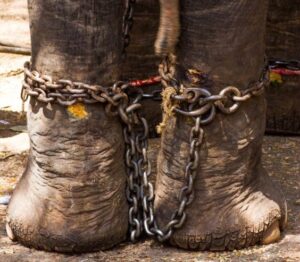
PART 2 ANIMISM OR BIAS?
What—not who—is Hecate?
Or CALLING OUT the RELENTLESS ASSUMPTION because, while thusly named, the woman sitting with me, with pink hair, a septum ring and a seriously impressive tattoo sleeve, is not it. Could Hecate, then, be a species, or a landscape? Or an ancestral, tribal name? Or a collective noun for a pack of stag hounds?
Dogs were closely associated with Hecate in the Classical world. “In art and in literature Hecate is constantly represented as dog-shaped or as accompanied by a dog….[8]
I have to stop here. I want to raise a supposition with you. The concept of both sovereignty and lineage. That all the ideas promoted by academics over the past few centuries encased in the righteousness of the written word, are wrong. They are biased. The bigotry of grave robbers and Mengele-style categorisation of non-Europeans by way of skull measurements.
Whether promoted through tomb meddling, or the guesswork surrounding deserted metropolises, villages, buildings, menhirs or painted underground archives (archaeology), or whether through the finding, and subsequent classification, of human-like statuary, from the small figurines given the titles of Venus of Willendorf, the Minoan Snake Goddess, a figurine unearthed at the mythical Aratta, the guesswork, after the brain-frying indoctrination of almost two millennium of purposeful ambiguity, needs, from my perspective, to be challenged. This male female, human/god divisiveness… time’s up..
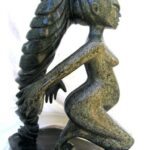
GOLD IN THE COALMINE
It would have been a Sunday because in 1982 we didn’t have the internet and I never bought a newspaper on any other day. The Herald. An article that caught me. That stopped me. That challenged everything I thought I knew. And these were the days of Erich von Däniken so that’s saying something.
An image on page 4, of a small gold object on a clear plastic plinth. It was now on show in the London museum. It was impossible to tell what the object was from the first photograph except that it was definitely, I reiterate, made of gold. The second image, however, had been photographed under a microscope. I was looking at a detailed carving of an F-111 aircraft with its landing gear down. That’s not the oddness, though. What boggles the mind is that it was discovered during the drilling of a new shaft—through a deep vein of coal—intended for an additional metro train tunnel. SOLID-FUCKING-GOLD! Hand-crafted: “Coal formation began during the Carboniferous Period – known as the first coal age – which spanned 360 million to 290 million years ago. The build-up of silt and other sediments, together with movements in the earth’s crust – known as tectonic movements – buried swamps and peat bogs, often to great depths. With burial, the plant material was subjected to high temperatures and pressures. This caused physical and chemical changes in the vegetation, transforming it into peat and then into coal. Source
So, who made it? And when? And what—by the love of earth—why and how is it there? And what of the consensus that promotes the concept that we’ve ‘progressed’ up some evolutionary ladder to be the elite species we are now when, it is just as plausible, EVERYTHING postulated as a straight-line-time-construct is utterly wrong and that we, as a species are under the thrall of some Cargo Cult sleeping beauty spell and that all our technological advancements are because we’ve done this shit before.
CARGO CULT: The term is now broadly used to describe behavior where people mistakenly think they can summon some benefit by going through empty or unimportant motions. They don’t understand the real consequences or causes, but they try and get a result anyway. You can see this is science, in programming, and in agile software development. In fact, it is quite common indeed. Source.
I could be called a liar because, in 2003, when I traveled overseas on my first world tour, I asked about it at the museum while I stopped over in London on my way to Mme. Tussauds and, hopefully, Camden Town. I was smiled upon by the woman at the information counter. I was informed there was no such item. So much for truthful journalism and fake images, eh? Back then, even! Before Trump! And what has manipulated our thinking? And could all these academically clever bastards be absolutely guessing, based on (and to justify/sanction/federally fund) their crimes?
CRIME AGAINST THE PEOPLE
We are in the internet age (I know, I know, fish are wet). That is sometimes wonderful and at others, confusing. When the original story of the many-beasted, tattooed woman, entombed in the permafrost of the Altai Mountains, beneath the mummified remains of four horses, was first presented, again in a newspaper, back in the 90s, it was proposed that she was a shaman. Entering the Circle: Ancient Secrets of Siberian Wisdom, was written byOlga Kharitidi, exploring the effects of such a powerful figure on all who came into contact with her. Now every search engine titles this mummified individual as “a princess”.
What are we? Idiots?
JUNG AND HIS ARCHETYPES
No. Just no.
It is unfortunately plausible that these stiff-collared gentlemen are as much the problem of hierarchy as the rest of the so-called free West. The years of Jung’s life were the height of The White Massa, a Europe, Britain and now America deep in the throes of misappropriating lands, resources and species, in a worldwide blanket theft. Most religious, governmental, corporate and academic institutions were also seduced (as were the Grimms Brothers, amongst a plethora of others) by their own arrogant stance of conquerage and misappropriation. As accomplished in the brutality of others, by acquiescence, as King Leopold II, Hitler, Pol Pot, the entirety of the so-called British Empire’s elite and military prowess, up to, and including, its stance on nuclear experimentation at Maralinga and the American War, called the American War by the Vietnamese, and including the bombing of Hiroshima and the subsequent trials of such weapons of mass destruction on the peoples of the Marshall Islands.
What are we to believe? That men like Jung were valid exponents of wisdom? His treatment of a collective unconscious based on his own, and his poor mad mother’s, sad spack-outs? Was laudanum, thought a cure for a woman’s hysteria, her only escape when, perhaps, all she needed was be heard? Europe’s elite boys basked in the educational institutions that were glorying in a golden aged renaissance, particularly in England, during the brutal poverty and disease the rabble needed to experience for them to remember their place (a jolly cool way to prevent a revolution, eh what)? An historic moment—the height of empires—when pulling teeth was thought to cure insanity in the brain, and heroin was the cure, du jour, for a cocaine addiction?
The late nineteenth century was an era steeped in the mysterious and the suspect-occult. Séances and spiritualism, masonic and grail lodges and African/Graeco/Egyptian orders, the secrets that explorers thought they had discovered: black magic, voodoo, pointing the bone, the skulls of massacred Zulus, the severed hands of Congolese, the remaining drums of murdered Saami. Perhaps exuding some mystical power that a pale European with a gun and a private army could claim and wield against satanic corruption.
The pale-skinned man’s pith-helmeted condescension, entering the approximate 70,000 year territory of the Arrernte people and thinking to understand a culture utterly unremembered as having once been his own? Him walking amongst what remain of the survivors of the Trail of Tears and asking whether they will now accept jesus into their hearts while handing out smallpox-riddled blankets and 80% proof rum while, for god’s sake, put some fucking proper clothes on! Hanging out with the Inuit and trying to understand a language of clicks and throat singing, gagging at the thought of seal blubber as a staple food source whilst, simultaneously introducing them to the sugar so brutally harvested by slaves in the Caribbean? Spending days, stoned on coca leaves, or intoxicated on whisky and their own sense of imperialist Gauguin-ness, in New Zealand and Tahiti, while being fucked by native girls and misinterpreting ancient lore into something like a dictionaried language?
Agreeing to a straitjacket and a metal-framed cot, including wrists straps, in Bedlam? Criminalizing the remembered ancestral knowledge of Africans now enslaved by the Portuguese in Brazil, maybe? Or, as in the Congo, with the severing of hands that Little kingly Leo (the second one, not the first) figured was a great idea if the people who had actually always lived there didn’t meet his concept of a rubber quota?
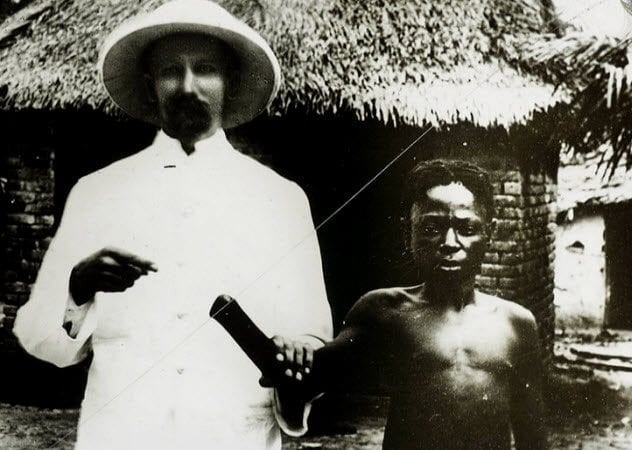
PART 3 QUESTIONS, QUESTIONS
TERRA NULLIUS AND SHEEP
AUSTRALIA. The Killing of Ecosystem (oh, and people): “For most farmers, land is their most important asset. Agricultural land is also an integral part of the Australian ecosystem and has a significant environmental value, of which farmers are responsible for managing approximately 385 million hectares (or 58 percent of Australia).” Source
AFRICA. The Killing of Dignity (oh, and people): “Those who survived the desert were herded into concentration camps and were forced to dig up Herero graves to retrieve the skulls of their dead relatives. Women were forces to skin and boil the skulls, which were used in German experiments to prove Aryan superiority and African inferiority. Of the more than 80,000 Herero population, only 15,000 survived.” Source
IRELAND. The Killing of Self-Determination (oh, and people):“British viewers were truly shocked to discover the brutality of the Great Hunger Many of them had not previously known of the death of at least one million and emigration of a further million of their closest neighbours in what must be regarded as the darkest and most horrifying seven years in Irish history.” Source.
SCOTLAND. The Killing of Heritage (yep, people): “In the first place, the Highland Clearances transformed the cultural landscape of the Highlands of Scotland, probably forever. In the space of less than half a century, the Highlands became one of the most sparsely populated areas in Europe. And, it should be remembered, the Highlands and Islands comprise an area bigger than some industrialized ‘first world’ nations such as Belgium or Holland. But it was not only the people who disappeared. The settlement pattern, the homes of the people for a thousand years or more, has virtually vanished, becoming no more than an archaeological feature for those who stumble across the remnants.” Source.
SKYE. The Killing of Their Own: “It is hard to read any historical account of The Clearances without a deep sense of injustice and a bewildering disbelief at how one of the most civilized and generally prosperous nations of its time could inflict such wanton brutality on its own people – and adopt widespread indifference to their plight. By the early 19th century Rubh’ an Dùnain had, some archaeologists suggest, endured perhaps 6000 or 7000 years of continuous habitation; there is tangible evidence of Neolithic, bronze and iron age activity and of early and late medieval settlement. Climate change over the millennia had a direct impact on the enduring patterns of life, society and culture; piracy, pillage and clan warfare were survived. But ultimately human greed and pitiless cruelty proved to be the more effective purgatives driving every last simple, hard-working person from the peninsula. Source
WALES. The Killing of Language: “Welsh must be one of the only languages in the world that is hated simply because it exists. Simply because it defies Anglo-Saxon and Norman history. Simply because its existence seems to be such an embarrassment to some of the English. The angry blog posts written by monolingual students are almost embarrassing enough to not warrant a response. Because it is only a monoglot who cannot understand the importance of language, because they have never made the effort to learn another.” Source.
Of course, the above references are a pittance. And just about now—before I head into the wind of misappropriation by those wishing to claim an ancestry neither honest nor theirs—there’s this:
Two years later, in 49, Ostorius confiscated land in and around Camulodunum to set up a colonia. This was a town for retired Legionaries, in which each veteran was granted a homestead. The town gave the veterans a secure retirement and concentrated an experienced reserve force in the new province, on which Rome could call in case of emergency. In theory, it was supposed to provide a model of Roman civilization to which the natives might aspire. Unfortunately, the colonia at Camulodunum caused more problems than it solved. As it grew over the next decade, more and more Britons were driven off their land, some enslaved by the veterans, others executed and their heads exhibited on stakes. Source
THE POINT
Who are we? You, me, the people four suburbs away, the farmer on misappropriated (that means stolen), beaten, poisoned and degraded soil? The person giving a talk at the gathering? What is pagan if not an Italian word, and why would I perpetuate its use as a designation for animism when I am not Italian? What can I call myself to belong? Is that why we do it? We are, perhaps, clannish by our very nature. A pack animal. Are our tribes prone to violence and hooliganism, at a football match, because of a pent-up frustration at not being an honest species with a clear understanding at whose side we’re on? Is that why the so-called British are such boozers? Alcoholics? During the COVID-19 pandemics the libraries and bookshops closed but the bottle shops didn’t. Do governments know what would happen—en masse—if they closed the licensed poisoner joints? What? Even more dead wives?
And we have been taught to name everything. To objectify everything. Despite a thing being a public assembly or a gathering for whatever reason, and not an object with no previously-identifying division from any other thing. If I was Irish, I would say a ting, or ignore the existence of the ð altogether (Tuatha is pronounced too-ah) while, if a Cockney or a Maori I would pronounce a thing as a fing. Let’s face it, on the whole, generalizing as I am not usually prone to do, we’re fucking lost.
We’re wingin’ it. We’re still relying on antiquated texts and innuendo that are written by an elitist, classist, religious and sectarian anti-linguist with a permanently hunched back from bowing so very lowly, because to do otherwise ensures a whipping, a fifteen year stint in a Siberian gulag or a trip to colonial Australia where, like Angus McMillian, born in 1810, and whose family was subject to the savagery, of those aforementioned Highland Clearances, blokes in the English (NOT British, mind) queen’s blue, and, as such, blessed by god and gun, authorized to just slaughter every rightful descendant, of a minimum 70,000 year inhabitation, because they were here first and that just won’t do! Not when what happened, to your own family in your lifetime, actually and really happened. Despite it being three months away, by ship, and the colonizers not knowing one fucking word of the First Nation elders, especially not the word NO.
After all, you behaved, din’t ye laddie, and got the fuck out, like a braw wee man had to do? They gave ya a gun, didn’t they? The lairds who took your land and sent you to this abysmal blue-skied anomaly?
Wheat and sheep and coal and all that hardwood! While we continue to be the problem of head-in-the-sand bigotry towards anyone unlike us, we’re busy seeking to legitimise ourselves in costume and device.
I’m not being mean. Why would anyone think that?
GO BACK WHERE YOU CAME FROM
I’m first generation born within the sprawl of Sydney; a mere six years after America bombed the living fuck out of Hiroshima and Nagasaki, heralding the onset of a nuclear proliferation version of don’t touch my toys that has not, yet, ceased. And that certain nations continue spruiking is the road to the final, holy grail of acceptance: one obtained by the gilded front teeth of a bully-state and a ministry of nuns with whips and scissors and lye soap. Oh and starch.
And all the while there’s this new thing. Is nationalism, the invention of a cultural identity, a copout? When racism is dividing humanity? Well, it has done all my life, so it can hardly be called new. Segregating us along skin-color lines or by the construct of worthiness-by-wealth-or-title, is about as rational as cutting down a forest to plant a lawn.
I love a sunburnt country,
A land of sweeping plains,
Of ragged mountain ranges,
Of drought and flooding rains.
I love her far horizons,
I love her jewel-sea,
Her beauty and her terror –
The wide brown land for me!
A stark white ring-barked forest
All tragic to the moon…Source.
There was a version of this, circulating when I was fourteen years old, that went: I love a bombswept country, a land of sterile plains, of battered fallout shelters and radioactive rains. Dorothea MacKellar [9] who, while enjoying the sights of Sydney harbor from her very, very wealthy and acceptably ‘Mother England’ heritage, was still Dundee. Because how can a body be rid of lore? Of deep belonging? Of a few Ice Ages of drinking from that burn or eating from the body of that boar?
DUNDEE (Dùn Dèagh) A Neolithic cursus [10], with associated barrows has been identified at the north-western end of the city and nearby lies the Balgarthno stone circle. The circle has been subject to vandalism in the past and has recently been fenced off to protect it. Bronze Age finds are fairly abundant in Dundee and the surrounding area, particularly in the form of short ‘cist’ burials. Source
I neither justify nor overly-examine my tendency to ramble. I could walk through a forest following a straight track with signs, written in English with some form of subtitling just to be sure I don’t get lost, or I can learn what I’ve been at for decades, which is to recognize landmarks, and leave accounts of them, rather than the signage, as, hopefully, the forest will outlive the signage. And when you and I both comprehend the marks carved in dolmens for precisely this purpose, both of us, and our children’s children’s children will be able to discover an ancestral home that legend continues to say is hidden in this vast and ominous green.
Your and my recent ancestors have subsumed and consumed other people’s lands and ‘resources’. Countries have been claimed (despite who was here beforehand: those indigenous ancestors’ skulls and jawbones that rage-in-amber from the dusty cellars of museums half a world away) and pitched, claimed and uniformed, through enforcement and subsequent acquiescence, to the point of a Cronulla Riot or a #blacklivesmatter campaign, or even more perversely a Go Back Where you Came From slogan: For a white person — and it’s almost always a white person — to say “go back” to a Native American, whose ancestors were here long before European settlers colonized this continent, betrays the real, white supremacist meaning of the phrase: We don’t want you anywhere at all … Source
… and you want to call yourself A witch?
MISAPPROPRIATION
Splinter groups of thus-called witches have evolved, somewhat like clusters of bindweed or cinderblock towers, that claim a lineage, a credentialed but quirky righteousness or, again, a fuck-you-I-won’t-do-what-you-tell-me mindset, are no different to those who drape themselves in the Australian version of the Bucher’s Apron (that includes the centaurus-pointing crux—the five stars that make up the Southern Cross of alpha, beta, delta, gamma and epsilon crucis) and think of it as some authorized national identity (despite Australia remaining a colony) who can beat the living fuck out of anyone with skin that’s darker than a second generation girl from Blackpool with a so-called (but deadly) ‘healthy tan’.
What’s the point? Are we that lost? Yes. Why?
I am a Celt. Are you, really? Yes. Are you sure? Yes. Okay. Aren’t you going to ask me what that means? I know what it means. What? I dunno, a white woman? A descendent of Finn McCool or Vercingetorix? Do you know how to pronounce Vercingetorix? Yes. Say it, then. Fuck me, you’re pushy: Ver-sin-get-or-iks. Um… What? There’s no s in the word, and get is pronounced like jet. Fuck you, bitch, I know what I know. Oh, sorry, not sorry… was Vercingetorix a bloke or a woman? A bloke, of course. Why are you so sure? Men are always warriors. What about Budega? Well, she was different. Why? I dunno, because she raised an army? Is that what defines history and a culture? Sure, it is, all those academics can’t be wrong… and she was magical except the hare got away and she was defeated. So you know the story? Yep. She must have been a fuckwit, though, for misinterpreting the way the hare went. Wow, is that like Trump is a good guy because he wants to make America great again? What are you implying?
Language is, or can be, like photography. People can talk and talk and talk and say nothing. We can write and write and write and just be repeating what has been said before, like a many-balled butt plug on its way out of its temporary anal incarceration. But then there’s this:
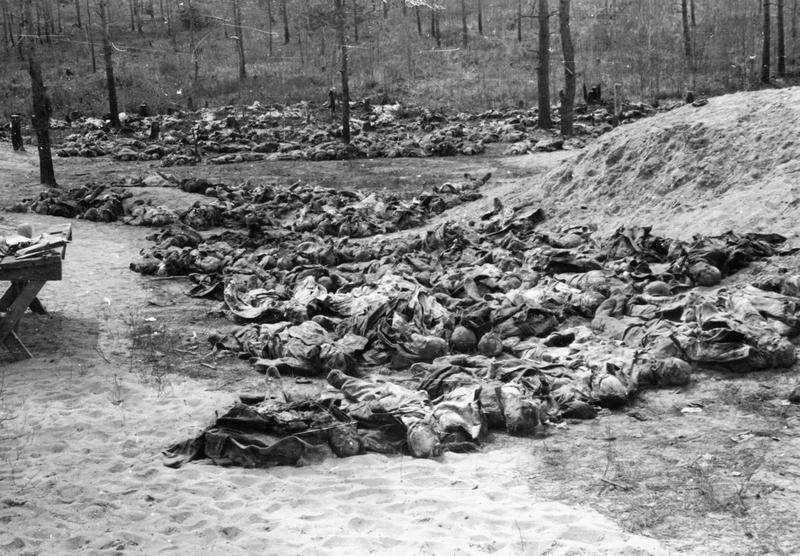
And sometimes one word is enough. Horror. Evil. Beauty.
So much is written in such as way as to roll off consciousness as a set of self-described facts. We can all do it. It’s acceptable.
It’s nothing.
These facts will last five minutes, or for the extent of an argument, perhaps even to delineate an identity but none of them can match that photograph.
Then take this:
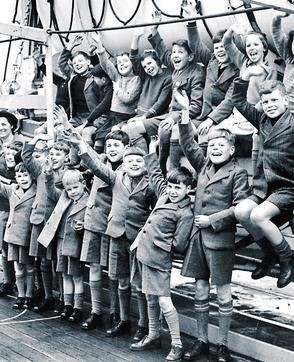
Or this monstrosity:
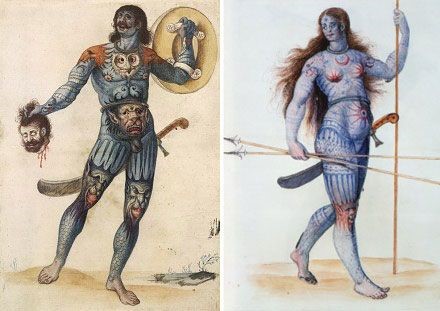
That then becomes this:
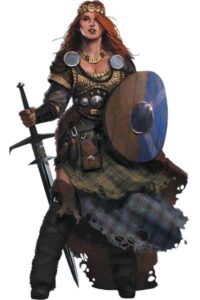
And here we are again. We have been caricatures for so long now that no one takes anything we say as valid or even real. It’s all recreationist, or re-enactment movements or more troubling and offensive, an excuse for far-right political extremism. A kind of still-white-bitches mindset.
Celticity is “an attractive set of symbols and identities that come replete with popular recognition and a supposedly ancient past that can be invoked by people for many purposes, from ‘new age’ religion to popular ‘world music.’” Historically, however, that “ancient past” is hard to pin down. Hague et al. explain: The very flexibility and the vagaries of archaeological evidence regarding the original Celts enable multiple political and cultural meanings to be invested in the form, whilst retaining the symbolic value and historical authority accrued by the reference to a supposedly ancient Celtic culture. “The Celts” can and have been envisioned in all sorts of ways: as a warrior class; a pan-European people; as the epitome of whiteness; “whatever version of the past seemed nationally expedient.” It’s a cultural identity that has come into vogue in recent decades. Source
BREAK AWAY, BRIGHT EYES
I come to the point of all this. Genealogy. It seems that for a narrow window of us-as-human-data-retention we can do this. I know aristocracy, royalty, several extant indigenous kinship recall systems, and horse-breeders all keep lineage records. But until the twenty first century people have been too busy recovering from 1848 and gender disparity to concentrate much on their family trees. Why?
Because they haven’t meant much. Your grandma on your mother’s side comes from Belfast and her mum was married to someone named Richard Dawson Bates, and so… Who? Doesn’t matter, does it? And my great grandpa, on dad’s side was born in Prague… but he never said anything about anything, so he was pretty useless, wasn’t he? He’s dead now, anyway. We didn’t visit him much and I don’t know when he emigrated here, but I think it was around 1945. What was his name? I think it was Tom Kubish, something like that. Nothing to talk about here, folks, I suppose. He was old when I was a kid and didn’t really speak much English. He was a heavy drinker and angry all the time. He changed his last name to Cubby to make out he was one of us, I think.
And? So what?
There must be some kind of way outta here Said the joker to the thief…
From All Along the Watchtower, Original lyrics, Bob Dylan, 1967 Re-recorded by Jimmi Hendrix, Electric Ladyland, 1968
In the booklet accompanying his Biograph album, Dylan writes: “I liked Jimi Hendrix’s record of this and ever since he died I’ve been doing it that way… Strange how when I sing it, I always feel it’s a tribute to him in some kind of way.”
STORYTELLER
What we are experiencing, in the above quote, is how a story evolves, depending on the storyteller. Genealogy was first realized as important when the names and the years of life and death coincided with either local, national &/or world events.
How could my made-up buddy John Cubby know that his poor, now-dead grandfather was Tomáš Kubish, possibly the brother, or cousin, to the famous Jan Kubiš? How did he come to emigrate here? Why does his steamship travel document mention him as being from England when the notation on the family tree clearly states he was Czech? NOW are we are getting somewhere? Now does our bland, bitter, invented John represent a mystery to be researched? Does it matter? DOES IT MATTER? Do John’s unborn children matter? Well?
Perhaps it’s true that things can change in a day. That a few dozen hours can affect the outcome of whole lifetimes. And that when they do, those few dozen hours, like the salvaged remains of a burned house—the charred clock, the singed photograph, the scorched furniture—must be resurrected from the ruins and examined. Preserved. Accounted for. Little events, ordinary things, smashed and reconstituted. Imbued with new meaning. Suddenly they become the bleached bones of a story. Arundhati Roy, The God of Small Things
I won’t say lineage is a pure thing. The hand that documented all that information was so often pissed drunk that my friend (and the person who extracted my own family tree from the occult archives of a careless bureaucracy) who is a genealogist of at least forty years, will sometimes spend several hours in front of a twelfth century document that, looking over his shoulder is—to a peasant like me—indecipherable gibberish.
They wrote between the lines when they remembered they’d done a baptism, he says. That s is an f. the y is th and looks like a d. Ye Olde Bookshop is actually THE Olde Bookshop. Fuckwits. He snorts derisively, tucking one hand to within the folds of his long sleeved dark wool robe, pouring and downing a shot of Jamesons, his best thinking done when he is out of it on something, as many geniuses are apt to be.
Shall I try to read the page? No. Do I give a shit when he traces my matrilineal ancestors through the sap of winter silence? No. They seem boring. I relate to the names just like John did his Tomáš. And all the while my OCD compulsion draws me to Thetford Forest, Inish Mȏn, Culloden; to Cú Chulain, Scáthach, that bastard Suetonius Paulinus, yes Vercingetorix. And Julius Caesar’s penchant for torturing the native captives of Albion. Why?
I was there.
I’ll repeat that.
I was there.
Or, if I am a proper storyteller, I am there (and ‘there’ is me).
That’s the realization, when my huffy, Bill Nighy-type friend eventually prances into the room where I am sprawled, watching Botched with unconscionable fascination, and lays down the throwaway line I found you someone who wasn’t English. Oh, yes? I say, hardly pulling my eyes from the image, of the deviated septum, on the telly. Yes, he’s Welsh. I turn towards my old friend, more out of politeness than interest, and he says the long-dead relative is Caradoc ap Silures. Only he pronounces it as sy-loooo-rez when, to be proper, the tribal word is pronounced shileresh. SILURES? CARADOC? How far, the fuck, down that root have you gone?
Turns out, as far back as taxes.
And the Roman Empire taxed, or extracted goods, slaves and tithes, from everyone. Records were kept. Census taken. If a body owned land, cattle or other people that were negotiable, their names were recorded. Through war, invasion, conquest, religious persecution. We’re there. Somewhere.
You’re also related to Charlemagne, he adds before leaving the room. But so is everybody, the randy old bastard. But I’m still in shock. I know this man. This Caradoc, who is not an ap Silures, but who fought with them. The Silures is a tribe. In what is nowadays called Wales. Good Sisters of the Night, I am found!
The question is, did I know? Is that the fascination many of us encounter with the ‘ness’ of certain peoples of the world? Is this some phylogenetic, common ancestor memory? Of course it is. Of course it is. And it doesn’t matter if we travel the coastline from Unst to Nunavut, in coracles of willow, covered in seal hide, and waterproofed with pitch, for many thousands of years.
Until the ocean becomes too vast for such trading options, with the dramatic recession of the permanent ice, so that we only get to go as row as Kaffeklubben until, of course, someone rigs a knörr and brings the fucking sheep.
WHAT IS THIS?
The above image is a page in Luna Baily’s book A Modern Witch’s Guide to Happiness, and the blurb on the Booktopia site states (as, apparently, a promotional tag):
“It’s time to give your inner witch a voice. Unlock the magick of modern witchcraft and infuse your every day with happiness.
This is your essential spiritual guide to happiness. Including everything you need to know to become a modern witch, from working with tarot cards and healing crystals, to taking direction from the stars, this book will teach you how to harness the power of the natural world, dispel toxic energy and develop your own psychic ability to find happiness.”
I wasn’t looking for an article on this book but I stumbled across it anyway and figured this was the exact article in which to mention it. Buy it and do what thou wilt, I say. Good luck to you, Luna. I think it’s fitting, before I complete this article, to give you an idea of what is out there, and how witchcraft is now perceived. This and the glossy PR website of specific Sydney “modern” witches (in difference to what? An old fashioned kind?) who make a killing (excuse the pun) selling courses on how to do this stuff and charging a few months wages to take your pale, talisman-endowed, light, white summer frocked, Anglo-European self to “places where Goddesses still live and where they inspire us to let go of the burden of the everyday”.
JUST VISITING, CAN’T STAY
I watched a hastily-shot video of a friend giving a talk at an eclectic gathering of diverse Anglo-European pagans in Western Australia. She talked about authenticity. Her ancestors are both Albanach and Norse so she chose to discuss two ideas, relative to Norse mythology: the concepts of Wyrd and Orlog—examples of which are blogged about here or, Mother Time forgive me, and here. My friend is as authentic as that indigenous Pictish Druid (fuck me, I mentioned him somewhere) who met me at Rock n Roll Café; as authentic as I think I am.
I just wonder about the summoning of language and meaning, from an archival burial ground, to indicate that we, too, have something of a story to tell. To justify our right to be here. An ancestral heritage that can endow relevance onto a reconstituted, pre-industrial, pre-decimated elder lore that is almost as extinct as records of us.
We KNOW we are lonely. We, of the pale faces and the hot showers. We, the secret consumers and money makers, from off the backs and cultures of stolen, dawn-of-time spiritualties. We, the homeless, living in houses built on the backs of the extinct and the driven out. We the segregationists with the thin veneer of #blacklivesmatter solidarity; the Brother, we march-beside-you. We do! We do, until the rubber bullets and the baton-bashings that won’t affect us because our skin is that of an obviously fog-and-ice hue, and we’re wearing Gucci–or Target–so get off my fucking neck you dickweed, fucking, copper! We are. We. Are Fucking. LONELY!
Using traditional Aboriginal Australian songlines as the key, Lynne Kelly has identified the powerful memory technique used by indigenous people around the world. She has discovered that this ancient memory technique is the secret behind the great stone monuments like Stonehenge, which have for so long puzzled archaeologists. Source.
I attend a talk by Dr. Lynne Kelly on mnemonics, from her book The Memory Code. I listen to her discuss her precision understanding, of the vastness of knowledge, carried in the memories of non-literate people, and I am lonely.
I listen to Bruce Pascoe speak, in A Sky Full of Secrets, Professor Marcia Langton on Q and A and Marjorie Tahbone, an Inupiaq tattooist and activist… I literally tremble as Meyne Wyatt delivers his monologue on racism. And, like Takaya, the last sea wolf, I am LONELY. Meyne Wyatt, monologue, Q and A, 2020
SITE, AFTER SITE
Of the King Penguins, Île aux Cochons, a barren volcanic island halfway between Madagascar and Antarctica: Nearly 900,000 of the regal, meter-high, black, white, and orange birds had disappeared without a trace. “It was really incredible, completely unexpected,” recalls Weimerskirch, who works at the French national research agency CNRS. Source
All these people seeking to present us with themselves. Asking that we (I use the word loosely, apologies) see them, because corporations and institutions are still steamrolling cultural and land practices, slaughtering wolves and whales, poisoning waterways and fracking a limited future at the expense of uniqueness and places that we (any of us) have no business going near, without permission and grace, and the other people-animals of earth and sky and sea are TRYING to get us to FUCKING-WELL BEHAVE.
PART 4 – SEISMIC SHIFT
CAUGHT IN A LANDSLIDE
LOST
The stories we perhaps tell now, around huge fires before the onset of an indefinite winter, nights reminiscent of long, ectoplasmic mists of another age, often summon a longing so overwhelming it is an ache. One that has me holding my ribs and turning away from the crowd; of an age before mobile phones, before social media, school, job applications, dentists, ties and high heels, before ooshies. Because these stories are tedious. They serve as no navigational education whatsoever. They do not advise me of how to make an awl. They are twee. Memoraphobic (is that a word? It is now) and meaningless with 16th Century monkish babble, considered, quizzically, as valid… somehow.
Time: you twisted motherf#*^er.
We don’t know, at all, when this is. When we are. When anything. This era might not happen for another thousand years. Until after another Ice Age. It might not have happened in the era we call time because that word—time—does not exist in the languages of certain cultures. And yet most of our stories, the ones mummy reads us before we can do so for ourselves, begin with Once Upon a Time. And the problem we face here, in the regurgitatedly abstract West.
“For the Amondawa, time does not exist in the same way as it does for us,” he says. “We can now say without doubt that there is at least one language and culture which does not have a concept of time as something that can be measured, counted or talked about in the abstract. This doesn’t mean that the Amondawa are ‘people outside time’, but they live in a world of events, rather than seeing events as being embedded in time.” Professor Chris Sinha, Language and Cognition, Source
Preservation of stories such as those related to Lebor Gabála, the Iliad, the Eddas (poetic or prose), all things Bible, are useless, garbled, misunderstood and meaningless. I won’t justify this to make it easier. So, also, are the stories presented to us, as a human animal, as history. That last one is a doozy.
Western history is written as an abstract. If not consisting of bloodshed, conquerage, hierarchy, political upheaval, conquerage, discoveries of people, objects, a Rosetta Stone or a Nag Hammadi codex (that oops, already existed—you can’t find what isn’t there), conquerage, war of any kind, economic or religious, um… conquerage, it’s not, well, history. You don’t exist. I don’t exist.
But we do. So how is history an honest record of human being, when we, as human animals, are peaceful? When we are non-literate?
In the words of Tacitus, Christians showed “hatred of the human race” (odium generis humani). Among the more credulous, Christians were thought to use black magic in pursuit of revolutionary aims, and to practice incest and cannibalism. Source
From what I remember Tacitus said the same about us Celts, oh, and the Gaulish. Anybody not Roman. Most, if not all of the stories, presented to and by anthropologists relate to people of non-Anglo-Europeanness and ‘interesting’. Or ‘unique’. Or ‘primitive.’ And, until recently, as ‘uneducated’ and therefore subject to the rules of a taker/consumerist/stockholder mentality: dispensable.
The same applies to language. To the practices of hunter-gatherers and nomadic herders that do not concede ownership of the person the Aymaran and Quechua languages call Pachamama, that my own Brigantach and Catuvellaun ancestors called……….
Who are we without language? What have we become and who are we to believe?
“Not only did William the Conqueror have the nerve to, well, conquer, he also nicked our woods. England had always been a paradise for trees, covered from the end of the last ice age in increasingly dense forests of oak, hazel and birch, with some pine. When early islanders began farming, the tree cover slowly began to give way to pasture and cultivated land, but under Anglo-Saxon kings, the forests still belonged to the landowners and their subjects. William, however, introduced “Forest Law”, which claimed the woodlands as the hunting grounds of kings. Anyone stealing or killing a deer or boar would be in a whole heap of trouble: by the end of Richard the Lionheart’s reign in 1198, that punishment was mutilation, including the removal of your eyes and other unmentionable parts. Source
After all is said and done, the situation is like being trapped in a funfair’s Hall of Mirrors. Deceptive. Inescapable. Quite possibly the cause of a lifetime of physical dysmorphia, and also, quite probably, untrue. One can get lost in images of oneself or others that are warped and slanted to appear the way some sniggering malcontent decides they will.
Until what is know as the 17th Century common land was forest, river and fen, shared by everyone within the vicinity. Then the fences went up. Then the starvations got worse. Then the transports. Once the travesty of enslavement of mainly Africans, for free labour on the colonialist rubber, potato and tobacco plantations, now focused on England, Ireland and Scotland, calling poverty or activism a crime, and if not executed, this desperate or angry population of beaten people, dismissed as pointless flesh, was condemned—individual, family, or entire tuath or clan, to penal servitude for however long the lairds, clergy, sheriff—or the Old Baily—decreed should be the penalty for standing up to the destruction of ancestral land or the theft of a sausage to feed the kiddies.
WHO ARE WE NOW?
Australia is not our country. Australia isn’t even a country. Not in any real sense. “The name Australia derives from Latin australis meaning southern, and dates back to 2nd century legends of an “unknown southern land” (that is terra australis incognita). The explorer Matthew Flinders named the land Terra Australis, which was later abbreviated to the current form.” Source.
I’m not trying to be argumentative, just getting to the point. This… this theft is still being perpetrated, exploited and overridden by an attitude that says, just shut up, believe you live in a democracy, that you are not part of the problems associated with environmental vandalism, human trafficking, classism or the chasm of extinction that threatens EVERYONE. Burn some incense, hang a dream catcher in the window, perform a ritual to save Ronnie from heroin, and his mum from eviction because he stole her monthly rent, or cast a circle, deasil, to celebrate midsummer three days before you go to your nan’s for christmas dinner.
About now, as I’ve mentioned somewhere before, I bend the knee to the Wurundjeri and the Boon Wurrung, the traditional custodians of the land where this house has been built, without their permission, without consideration and without negotiation. I offer respect to their Elders and, in unquestioning sincerity, without saying “past’” and “present”, rather preferring the truism “always”.
BACK TO HECATE
She’s forty nine. I remember being forty nine. All my kids raised. Me thinking I knew everything. Stuff like that. Her hair is dyed a precocious and eye wateringly fluorescent pink, and a really lovely septum piercing dangles above her top lip…
“Here’s an idea, Hecate. Why don’t you tell me the name your mother labelled you when you were born?”
“No, that’s just not—it doesn’t reflect what I believe.”
“What was it?”
“Simona. Davidson is my last name. It is my married name so I’m killing it eventually.”
“Why did she name you Simona?”
“I don’t know. It’s Polish or Czech, I think. It reminds me of that old seventies Knack song My Shirona. My mother used to sing to it when she played the cassette, but she’d change the words to My Simona. Which is why I hate it.”
“Your mother is Polish?”
“Was. She’s just an old woman now. No accent or anything.”
“Were you born here or in Europe?”
“Here. My great-grandparents came here to escape the war. To Sydney. From somewhere near a place called Dziedzinka.”
“How’s it said?”
“What? Why?”
“There’s more to this story of you than you’re telling me.”
“You know that how? Oh, sorry. You’re psychic… I wish I was psychic.”
“I’m just REALLY nosey, is what. And I love a good mystery.”
“Jijenah. She called it Jijenah.”
We sit a while in silence. She’s all of a sudden become very withdrawn. Then she seems to shake it off and, when the waitperson comes our way, she orders the vegetarian special off the board, and another coffee.
“Whatcha thinking?” I ask.
Observing her is like watching a storm roll in off the sea. It’s almost ominous, and I say a silent thank you to the land that I have met her here, and not at my house. Just in case, like.
“Mum wasn’t their only grandchild. They had other kids—my great aunties and uncles—but they acquired Mum, daughter of their disappeared own daughter. At least, that’s what I remember. Mum doesn’t mention anything if she can help it, and as far as I know everyone she’s related to is dead.”
I search her face, examining, so obviously un-English. “Come again?”
“It’s like my great-grandfather. He had a glass eye, but I was always so used to it I forget to mention it. I don’t know if they were real family or not. Nothing is clear. Once, when I was little, our Babcia–that’s Mum’s great-grandmother–said getting Mum took a day’s paperwork to fill out.”
“She was adopted?”
“Sort of. Yes. No… She was taken in. The family name was Kossak. I remember, years later, thinking that was what Russian dancers were called. What has any of this got to do with witchcraft and the workshop?”
“Everything. I agreed to meet you to find out who you are, yes?”
“Yes.”
“Then, who are you?”
“I think I probably should have a talk with Mum.” She fiddles in her handbag for her phone. It’s vibrating. She switches it off and dumps it back into the gloom. “But we don’t get along. She shits me. She’s moody and angry all the time. Silent. It gets hard to be around.”
“You got siblings?”
“Nah,” she smiles. “I don’t think she liked sex. I asked her about it once. I had to clean the bathroom for a month.”
“Simona, will you find out? Will you phone me when you know her story? Yours, really. Anytime, eh? I’m up for it whenever you can. But yes, I’ll see you at my house next week for the workshop.”
We eat in silence. The mynahs are relentless. As each table empties they swoop. Taking whatever is left over from the plates, siphoning the sugar from the cannisters. They are so brave; so fearless. I wonder, for the thousandth time, about size and how we presume that because a critter-cousin is smaller than us that they see us as bigger. Or is that some mental construct? A duck attacked my car one time, because I drove too close to where his mate and their children walked, in single file, towards the creek out back of my old house. That duck didn’t care. My big black Toyota fourby was a threat. He would have killed it if I hadn’t kept going.
WHAT DO WE DO NOW?
I’m putting my few things in my bag. I’ve had enough of company for one day.
“Her other relatives were killed or taken; disappeared.” The intensity on her face is like when the kindling finally catches the flame from the match. I feel something in my gut. “I think that’s why she was in the orphanage. How the family found her. I have no idea, really, but I’m sure they knew how to find her. Knew of her. They were allowed to take her. Nobody says anything to anyone in my family.”
“How much do you know?”
“Snatches. Bits and pieces. I don’t know if she’ll tell me because I’m pretty short tempered towards her.”
“How old is she now?”
“I’m lousy at math. She’ll probably be dead soon, though. I think she was born in maybe 1942? I know she was four when her grandparents found her. The war was still devouring the world. I don’t think any of them were Jews though, so I’m not sure why it all went septic.”
“Hang on. What?”
“She was in Kraków. Or was it Warsaw? She once said she was surprised they’d come. Like it was magic. Even though they never found my grandmother…”
“Records were very explicit, even then,” I add, remembering.
She’s weepy, and has to blow her nose on a tissue. Then she doesn’t know what to do with it so she shoves it deep into that abyss of a handbag. She is rattled by our conversation. By what she’s remembering. “They were actual blood family. The only ones left alive, it turns out. They paid to find her. If they knew what happened to Magdalena–their daughter, my grandmother–they never, ever said. Is this confusing?”
“No. Was she dead?”
“Oh, god—”
She doesn’t understand, yet, that I’m usually unforgiving towards throwaway, unconsidered religious terms like that, but now’s not the moment to be pedantic.
“I have no idea. Mum told me she remembered her as young and very pretty. That she was taken away after she gave birth.”
“Taken where? Who was your father, then?”
“She only talked about it once. Just after Nicholas was born. In case–you know–he got sick or something. She said there were papers… Stuff I’ve never seen; never wanted to see.”
She looks at me like she’s drowning. We do that, don’t we? Dismiss the stories of our parents, or their parents, because we have a mark to make upon the world. A reason for being here that we have been inculcated into presuming is just about us, when it isn’t? When, in reality, we are the product of so many other people who have, literally, made us… well, us.
By taking herself a “witch name”, she is trying to free herself from being invisible and neglected, but owned, by a husband who has nothing to do with her heritage or her deep cultural roots–offspring that don’t contact her more than a couple of times a year. So much so that she has almost closed the door to a great, brutal, terrible and ultimately liberating ‘ness’ and witchery that she could never, until months later, comprehend.
Within a narrow, shabby St Kilda apartment, on nights of lamplit, cigarette-smoking, vodka drinking, onion-unfolding experience of enlightenment, Simona listens to her mother intently, knowing that she needs, for once, to shut up and not criticize the older woman’s unstable use of English.
Mandy—Amanda Katarzyna Wysmułek-Kossak, whose married name became a respectably Anglo Amanda Burnley—explains what she remembers (which is all snow and grey, cold, metal-framed beds, and shouting, fattish women in uniform) of her childhood. Some deep recollection of bullets. Of the terror of letting go of a loved hand. Of feeling nothing. On purpose, feeling nothing.
Of the day her new, old matka and tata came and took her with them in that big car. To the warmth of a coal fire. In an actual house. In the little village she came to know was Białowieża, not far from Białystokw where her own disappeared mama had, she learned, studied veterinary science and had fallen in love with a Communist man whose name no one knew, only that he got sent to a gulag, called Karlag, that was somewhere way up near Kazakhstan, 3,000 km east of Moscow, for the crime of having had an opinion. Forced onto the back of a truck with another thirty young men, dragged unwillingly from his love, leaving her, a slightly pregnant Magdalena, to face the consequences of her sin, in a hospice for disgraced women, and who then vanished.
Then, finally, the ship, and the sensation she will never forget, of arriving in Sydney and experiencing summer for the first time.
“I found out that I still could have relatives in the area,” she informs me after the first day of the workshop. “Mama and I, we didn’t stop crying when she told me. I had no idea. Sorry, I’m such a ditz.”
“That place. What’s it called?” I pull out my phone and pass it to her. She types in Białowieża and the search engine brings up a listing for a world-heritage landscape: one of the last and largest remaining segments of the immense primordial forests that once stretched across the European Plain.
To the story of another Simona, not a Davidson or a Burnley, not a Wysmułek, came to light over the coming weeks. A Kossak.
“She spent more than 30 years in a wooden hut in the Białowieża Forest, without electricity or access to running water. A lynx slept in her bed, and a tamed boar lived under the same roof with her. She was a scientist, ecologist and the author of award-winning films, as well as radio broadcasts. She was also an activist who fought for the protection of Europe’s oldest forest. Simona believed that one ought to live simply, and close to nature. Among animals she found that which she never found with humans.” The article enchants us to read further with this heading— Simona Kossak: They called her a witch, because she chatted with animals and owned a terrorist crow… Source.
My new friend would disagree, now, with the terms tamed, owned and belief, because we are already into the third week of the FERAL workshops, on rewilding language, but her life has just taken a turn into a hidden peculiarity that many discover, when the pretence, and the hurriedly-woven shawl, that hides the escape map, begins to unravel. Her grandmother’s disappearance is unresolved. Passage to Poland is already booked, in hope of answers to both her parents and her grandparents. The airline is holding her ticket until the COVID-19 scare passes.
Simona is only beginning the search of her identity. But consistencies with fact can sometimes be unusually compelling. They could lead nowhere, or they could expose who she really is. Her middle son, Frank, suffered night terrors until he was twenty. From as young as aged fourteen he has had a fascination with Poland, and especially with Treblinka, the Nazi extermination camp. He now lives in Warsaw and is studying. He learned the language almost as though he had no choice, and is working towards a doctorate in environmental science. Simona has asked if it would be okay for her to stay for a while.
CONCLUSION
I am not audacious, arrogant, or stupid enough to suggest the legends, lore and mythology—the folktales—of any of many indigenous lands and people are better forgotten, because, at some moment in the course of being born and dying and being born the warnings, or history-couched-in-metaphor just might—in retrospect—be understood. Some unexplored Newgrange may yield a Rosetta Stone-style lexicon for translating the urgent need for remembering. And awe at the true meaning of Scáthach, and her mythological ‘sisters’, will come to light.
But to learn of them, and to create a caricature of identity around them to indicate you or I belong, is not an answer. These do not yield clan. Nor wisdom. Nor witchery. They do not mean you are their current familial representative of ancient and ancestral lore. Because to lose the hyperbole, inflicted onto us and demanded of us, as a christianized people (whether we realize it or otherwise), is to seem to leave us rudderless on an endless, compassionless and seemingly-inhospitable, all-powerful sea.
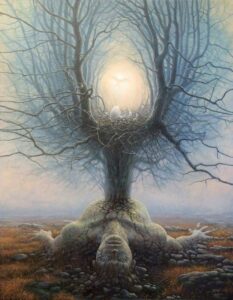
In Robert Macfarlane’s book UNDERLAND, he writes of his exploration of the caves of the Slovenian Highlands—
“Nailed to the trunk of a beech tree near the lip of the sinkhole is a metal sheet, two feet or so high, and blotched with algae. Written on it in black ink is a long poem in Slovenian, entitled ‘Razčlovečenje’. At the bottom of the poem is scrawled the word ‘PAX’…and later, on the same page, I feel a sudden horror reaching up and out of the sinkhole to coil around my heart. Something terrible has taken place here, and continues to reverberate… What happened here? The mouth of the chasm says nothing. The trees say nothing. Leaning over the edge of the sinkhole, I can see only darkness beneath me.” [11]
So, instead, tell the children the wisdom songs of your youth. Give them folk, and punk, and Stairway to Heaven and The Wall. Tell them of Martin Luther King and Eddie Mabo. Mary Wollstonecraft and Germaine Greer. Yes, you can tell them about Adam Goodes and Dame Kiri Jeanette Claire Te Kanawa. Tell them about Budega and… tell them of my ancient father. Have fun with old sex manuals and invisible hemming. They won’t know about any of it. These are new/old stories. Culture stories for the moment, easily lost. How to grow mushrooms and which ones will kill you. Which one’s will open their eyes. Let them know you know.
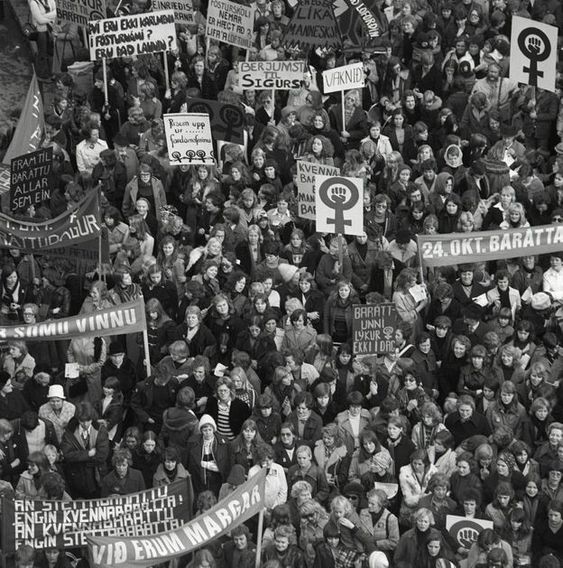
Tell them that the people laughed at Thomas Edison, as the building lit up on the eve of 1900; and they all said the electric light was just a fad.
Tell the tales of striving for freedoms unimaginable a hundred years before. They are not about conquerage.
…
Thanks to all who support my work
ANIMISM
Late into the night I sit on the back porch of this cottage at the base of Mother Mountain. Besides the brook, that has snow in her, as she swifts and chatters on her way to become sea. Wraiths are odd, though. And there are a lot of them although they were absent most of the season. Some illumine the willow like car lights passing but there are no cars. And besides, I have sat in cunning, to enable me to tell the difference (because a road cuts the track up, now, so yes, people pass in their pods. But the light is other). Some are gossamer in the limbs of willow on the bank opposite me, ragged as fog, but not in dissonance, more like lace with a design alien to my understanding of pattern, as is the me I think I am.
They were absent last winter but they’re back now. I’m a rationalist and, for a mystic, also, I retain a chunk of scepticism just to keep me sane, because potholes of confused ideas abound and I must decipher and decipher like a never-ending abacus.
I know that calling these phenomena “wraiths” is appropriate, so I’ll sit on the word. As I wonder. Who are you?
This speculation sometimes yields diamonds. I understand, or think I do, what night shows, that day can’t. With or without mist and fog and cloud night is crusted with stars. Whether we can see them or not. I breathe in, I breathe out. My eyes adjust to the light because night is never dark but is simply other than day. It is daylight that obscures, I contemplate, by nearnessing how far we can see.
The shock was there and gone, when I breathed one in. It happened so quickly but was unmistakable. I was washed in instantaneous comprehension. I didn’t realise it would almost kill me with the following illness, so certain was I that I am clever and these wights are benign.
I will admit to you that this is simply an epigenetic awareness. But. What if everything that earth is, in continuity as light bound in greens and blues and whites and blacks, informs our first indrawn breath at birth? Flooding our nervous system, merging, symbiotically, with who we are to become, other than animal flesh, in order for earth to know herself? Like an infinity of pores? That every aspect of earth—all perceived 4.453 billion years of our paltry calculations suggest (when in actuality we were everywhere, anyway, before ever gravity caused ellipse and spiral galaxy) forms our thoughts and the multitude of threadlike bytes of enlightenment that rise from seeming nowhere, some inner fathomless ocean, to provide excitation—an awareness of belonging—hence a pre-emptive to action and art? Hence consciousness? That it is not simply a matter (excuse the pun) of individuality as mutuality, but that because of the sheer endlessness of symbiosis, cannot be comprehended in entirety? Yet. That we reunite with this family of dance and infinitely huge, infinitely small light upon the thread, at the time of externally-observable death?
None of this denies instances of grief and sadness. Or confusion. Or self-doubt. None of it explains away the seemingly-odd behaviour of clusters and biological zap, but it’s the observation, isn’t it? The humanity, the individuality, that seems to die and compost down. Either singularly or as the result of a volcanic plume, a nuclear bomb, an avalanche of mud, or a starvation of millions. Extinction is impossible, you see? Isn’t it? What about thought, though? Where does the wellspring of inspiration come from and go to? For art, for revolution, for love? What if the wraiths are intelligence? What if each is a note in an impossible symphony, seeking vessels, planting difference, notes upon a keyboard so huge we are unable to comprehend; that compares itself to itself so that it’s voice will but heard, for a second, in what we call life?
An unquantifiable bigness that is home.
My question rings of, I realise, an almost intelligent design-like idea, but of an earthy, atmospheric, atomic—no wait—they’re all too large—kind. What if there is a ness in our genetic soup that attracts unique, vast, eye wateringly unexpected, wide, deep information that forms and shapes destiny Life to fulfil that which is impossible to comprehend other than by singularity?
What if wraiths are atmospheric things? That the mechanistic, Victorian-era machination of reductionism that allows destruction without thought.
What if, however, despite scientific rationalism, other?
And that each of them is, for lack of a more explicit explanation, entwined within the synapses of our flesh and brains and saliva and core, that when felt ‘inwards’ juxtaposes externalities with itself and therefore refracts back into earth’s self an equation of beauty when the flesh wears out?
Because no one cannot sense beauty; cannot recognise, eventually, a threat. The recognition may be unique to each individual but imagine, for a split second, if that’s all we ultimately realise.
Whether the person is three or a hundred and three.
Animism is the knowledge that all things are significant. Are themselves. Rock, sand, bed bugs, rivers, noise, violets, camels. They all exude stories. Memory and atom are woven together. They make tomorrow. No one thing has precedence, yet all will do what is their nature to do.
…
Thanks to all who support my work
