

Excerpt from Witch | For Those Who are
MULENGRO
Mulengro is a disease passed from one person to another using seven dysfunctional manipulations:
envy
greed
guilt
deceit
denial
expectation
assumption
PLEASE WRITE THAT DOWN OR TATTOO IT ONTO YOUR BRAIN:
When someone attempts to entice, control, coerce or otherwise warp seeming-facts to suit an agenda they will use one or more of these techniques. The only way to prevent despair from overwhelming our well-being is to cease mulengro in our lives. I’ve done it; several students have done it; most friends have stopped it.
The outcome to being infected by mulengro is always—
resentment,
rejection,
blame and
despair
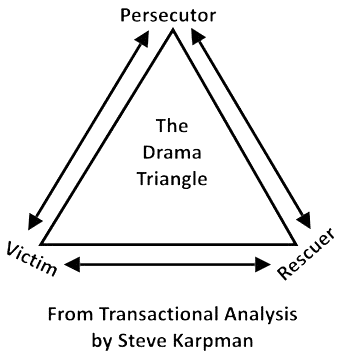
And mulengro is infectious. Mulengro is like the Karpman Drama Triangle: I read an article about a couple living together. I’ll call them Gabe and Kelly to ensure gender neutrality because this happens in every partnership at least once.
Kelly is at home and Gabe phones from the office, explaining there is an after-work function they are required to attend, and it could go until late.
Kelly asks, so Gabe, will you be home for dinner?
I doubt it, says Gabe, so don’t bother cooking for me unless you want to. I can always microwave it later.
Okay, says Kelly.
Oh-oh.
The problem begins when Kelly thinks to make dinner for two anyway, just in case Gabe comes home unexpectedly and is hungry. Partners do that for each other, right? They love each other. But Gabe does not come home and does not call.
Kelly, alone, does not get on with the evening and read a book. The thought is there, but thoughts also stray to the time, and how late Gabe is. And has there been an accident? Or is Gabe having an affair? Or—
Finally, exhausted, Kelly goes to bed, but cannot sleep because Gabe’s absence is now a monster.
At 3 a.m. Gabe comes home drunk, closes the door quietly, removes their shoes and creeps upstairs to the bedroom. Kelly switches on the light:
Where were you? Why didn’t you call me? I made us dinner anyway but then it just dried out and was ruined so I threw it away. Why are you so late? What have you been doing? I’ve been awfully worried. I didn’t know whether to call the hospitals or your mother or what! I’ve been terrified you were mugged or dead.
I’ve got to pee, Gabe slurs, swaying towards the bathroom.
You’re drunk. You’ve been partying and you’re fucking drunk! Kelly bursts into tears.
Gabe returns to the bedroom, undresses, gets into bed and is snoring in seconds.
What just happened? A happy couple is now on the slippery slide to an eventual end. Both are party to the drama triangle, also to every aspect of mulengro. At one stage Kelly enacts all three characters of the triangle whilst both display assumption, expectation denial and envy. Gabe’s silence is deceit. It is also denial and greed as surely as it is gaslighting and muting.
GASLIGHTING
Named for a 1944 film called Gas Light. The term refers to a psychological abuse and is used to describe an attempt to destroy another’s perception of reality, very often by sociopaths or narcissists, but there are multiple shades of that.
Very often an individual will lie to another, thinking to save them from the hurt of knowing, for example, that they had sex outside the relationship, and both do not want to admit it out of guilt, or wants to keep the external relationship as well as remain in the current
partnership. The problem arises when one person’s body (gut) gets the jitters. Adrenalin. Bodies read more than intellects and when one knows a partner as well as an intimate partner, or a parent/child relationship, bodies do the talking. Small things. A phone call not returned. A scent one cannot identify. Over time unknown patterns arise and the person being gaslit can become extremely ill. Anxiety. Fear. Confusion. If they ask the partner if something is going on that they should know about, and the partner says no. The relationship is, again, doomed. At the extreme, the victim of gaslighting suicides.
MUTING
When you have something important to discuss with a sibling, partner, offspring, parent, boss, misbehaving or inappropriate work colleague and they suggest you stop bitching, moaning, whining, complaining, they are muting you. They say, I don’t want to discuss the matter, or you’re talking out of turn, or I don’t want to hear this again. Or, you want to keep your job? Do you do it?
It’s aggression. It’s avoidance. The person raising the topic is effectively shut down. It can be threatening. You run the risk of being cast out, unloved, unemployed, disbelieved. How do we function as a society?
The need to tell the facts. To also admit when we’re wrong. To not inflict these psychological violations onto people we love or admire when we would not inflict them on a total stranger.
Because all the above are dishonesties. They seek to avoid personal responsibility. Accountability.
AUTHORITY
What connotations. The word authority has come to represent a pinnacle – the epitome of a powerful person. The word authority is quite different, in truth, to a master (such as a master carpenter, a
master of the sword, a master chef) because a person who has mastered a skill is a practitioner whereas, in many instances, an authority is someone with an opinion who confers with other people with opinions and who, therefore, could be considered educated in opinions. Of course, I’m generalizing but it is worth your consideration as quite often those who brand themselves as authorities do not condone having that authority questioned and that is, and has been, despotism or tyranny or psychopathy.
Whether the presumed authority is a parent, the president of a company or country, an educator, a five-star general, or a pope, it is the responsibility of an authentic person or society to consider the individual, or the institution, open to fallibility.
I sat enthroned on the dunny of a friend’s house, when I was younger, in the Australian state known as victoria, pondering the back of the door. The image, on a poster there, depicted a skeleton in a bathtub, in the bathroom of a hotel that is discovered in the far distant future by a team of archaeologists. They document the sarcophagus (the bathtub), the roll of paper used to send messages to the gods via an aqueduct (toilet paper and flush-toilet), mirror used for divination, various holy objects (like razor, toothbrush etc.) arranged on an altar, the obvious sacredness of water (realized, of course, from the profusion of taps), the quirky plastic crown worn by the king or priest of this temple (the shower-cap). On and on went the description. I understood that no one could fully know the past from the standpoint of the present and that all such sciences employ guesswork.
When I see a documentary on ancient people depicting them bent-over, ugly, hairy primates I tend to cringe, as nothing in life is ungainly in its natural habitat so why depict humanity, alone, as having been so? And primitive is merely deemed as derogatory in comparison to us now. To take upon oneself the responsibility of informed questioning ensures that authority does not take upon
itself the presumption it is better-than another, person, system, lore or knowledge just because it may not understand. It allows for possibilities, it allows for alternatives, it allows for error and it ensures that its own authority remains accountable.
THE JESUS MYTH
Pope Leo X, who reigned in the years 1513 to 1521, said: “It has served us well, this myth of Christ.” By this he meant that over the centuries, the vatican managed to acquire enormous wealth and power in the name of an era-characterization it called jesus christ. In the twentieth century, the man most responsible for making the Vatican a financial powerhouse was its investment manager, bernardino nogara. Speaking of him, a man named cardinal spellman, of New York, once said, “Next to Jesus Christ, the best thing that ever happened to the catholic church is Bernardino Nogara.” Anticipating that Europe was heading for war, nogara invested heavily in armaments factories, buying several of them outright. This allowed the papistry to reap huge profits when mussolini invaded Abyssinia in 1935 and in the second world war later.
RELIGIOUS FUNDAMENTALISM, DOGMA, BIGOTRY
It’s driven into children, in war-torn countries, brainwashing them into hating one another without them knowing exactly why. It is the arrogant racist who believes in an imperialist, white supremacy that presumes anything can be bought. It is in the neo-nazi and the ku klux klan. Fundamentalism is in the office worker next to you who feels her faith is superior to yours and that you will be damned for your viewpoint and your sexual activity and she, to a place thought of as paradise. Fundamentalism is the reason people mail anthrax to abortion clinics because they don’t believe a woman should have a right to choose what happens to her flesh-and-blood body.
Fundamentalism is the man who bullies, beats or represses his partner because he believes women are inferior – the source of all wickedness because of some middle eastern myth from life only knows how long ago—and passes on seeds of tyranny to his children. Fundamentalism is the people who mock same-sex love; people who shun unwed mothers, the poor, and those infected with HIV-AIDS calling such a terrible illness “the wrath of god”. It is people who smile politely to those of another race in public but who condemn them, in private, purely because of the color of their skin or the difference of their religion. Religious fundamentalism; religious laws, rules, arrogance, moral condemnations. A sure way of controlling people, don’t you agree? Divide and rule?
Divide et impera, the practice has been used socially, politically and militarily since documentation began. Philip II of Macedon (circa 365 BCE) is the first person quoted as utilizing the tactic. Divide us to conquer us. Diminish us. Instill doubt, envy, threat, fear. It is happening as I write, in politics. In the year that I write this politics wages a chess game of brinkmanship in league with big business and media. Do we buy into it? The challenge is to not allow it to. The challenge is to be very alert but to not become angry. They have us when that happens. Should we declare organic food our weapon, or peddle-power, or cloth bags instead of plastic, recycling over the next iPhone, if we should meet in an age of text-isolation, use pencils to remember how to write, gather in large numbers to protest the cruelty of factory farming and the imprisoning of refugees in offshore detention, if we could stand together so that education returns to being education instead of big business, not eat their garbage. Well, I’m with you on that.
The same applies, I am stunned to be informed, that in the post twentieth century ‘west’, spiritual practices known as paganism, shamanism, druidry, wicca and some groups that even call themselves witches, charge money to teach. To hold retreats. They sell products that we used to always make ourselves. The challenge of this essay alone is for us to learn. For us to hold our freedom and not be undermined because we see what is being done. To learn and keep learning. Then, to unlearn, when necessary, in order to deepen. To thunder into the future as creatures of Art. A future where wonder is revered, and Wildness, and the beauty that is Life is honored, where such terms as man conquers… in the battle to control… and in the war against… are no longer used to discuss natural phenomenon like Mountains, Space, Death. Actually, why use this terminology for anything?
RELIGIONS
Religions. What is valid about them? Whom do they serve? Religions demand worship. Rules to die for. They demand divisions and employ dualisms like good and evil, us and them, sacred or profane. Always divisive. Religions and the words worship, faith, belief all to go together. Inherent within these words is possibility of doubt. When we can gather for feasting and mutual learning, creating a barn, acommunity, a cleaner environment, without religion to bind us, we’ll have achieved a grail quest.
Many denominations and cults demand tithing, and blackmail, to ascertain entry into a presumed afterlife. The conscious smashing of this false idol of what is, beyond the confines of orthodoxy, a vital and energetic animism, is worthy of deep discourse. We, rightfully, need to ask permission of what we are to consume, before any move on landscape is made; before any food sources are killed.
Before any more secret poisons are added to sly and coerced sleep; to apathy.
…
NOTE
The spelling mulengro is a shortening of the form mulengero. This shortened form is used quite commonly in some varieties of Romani < mulhengero mulo (fog ghost), mulengero di (all souls day), mulo (dead) [these terminologies are from the Burgenland Romani dialect]