
THE SKIN-SCRIPTED PEOPLE of THE NORTH
#indigenousink: tatú, tatu, tattoo, tatovering, húðflúr, moko, สัก, irezumi, tatuajea, وشم, шивээс, peʻa

RECLAIMING HERITAGE
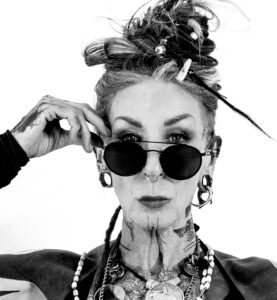
“I speak for those whose flesh remembers what stone forgot. I do not use the Roman word Pict. That was a label imposed from the outside—Picti, “the painted ones,” a watcher’s word for a people whose bodies bear meaning deeper than ink.
My ancestors know themselves differently: Albidosi, people of Alba; Cruithnig, the Formed Ones; Priteni, whose mark upon skin echoe their mark upon land, sea, weather and lineage. We are the Skin-Scripted heirs of the northern lands, those who inscribed memory into flesh long before empire wrote us into its margins.”
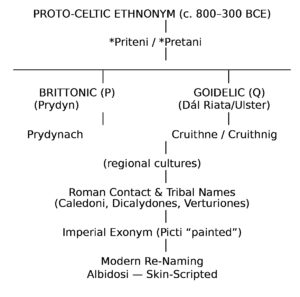
(For a tree of certain terms, see below)
We are world. World is not ‘my’ world or ‘the’ world, world is life: móðir, pachamama, mать, màthair, anaana. As Earth: Jörð, Talamh, Etügen Eke.
Across decimations, the desertification of vast ancient inland seas, the destruction of species’ habitats and the marginalization of incalculable peoples and cultures due to usurpation and conquerage by militant regimes and weaponized religious cults, we are alive. Our children are alive. Our ancestors flow through us on breath, through the rivers of capillary, vein, artery, heart, organs. Lightning disperses pain and grief, nervous systems, synapses, reaction and response.
Inking skin—tatú/húðflúr—is a healing art, a language and a statement of authority. It is not recreational, cosplay or copyist. It does not seek to represent our language in stone. That is revivalist and while we can respect that, it is unnecessary.
RELIGION, DELUSIONS AND LAWS, NOT OURS
Our cultures have been condemned by mainstram religion, particularly due to the farcical nature of a book called a bible (that simply means book), in one of its many violent texts, stating: “You shall not make any cuttings in your flesh on account of the dead or tattoo any marks upon you: I am the lord.” (leviticus 19:28) while a bit further on, is stated “A man or a woman who is a medium or a necromancer shall surely be put to death. They shall be stoned with stones; their blood shall be upon them.” (leviticus 20:27) and then, in leviticus again, 25:44/46 the author writes : “Your male and female slaves are to come from the nations around you; from them you may buy slaves. You may also buy some of the temporary residents living among you and members of their clans born in your country, and they will become your property.”

The above entered into law in many countries, with bureaucracies ruled over by minds of sewage and no recognisable backbones. We are judged, as are all indigenous peoples, based on some decrepit, Iron Aged texts, written in a language not our own, our ancestors from every desert and forest and mountain and valley not theirs. Taken by missionaries of a mythological tortured and dead man, that death at the whim of a daddy, just like the attempted murder of a kid named Isaac who had the end of his penis cut off because some unseen voice told his papa to use the blade in a somewhat unorthodox parody of slaughter.
Why do we put up with even a trace of these atrocities? Even as I write this, in the twenty first century, tattoo is antiquely assigned in certain venues in Queensland, Australia, as signifying a criminal or gangster. Until recently, in Denmark, it was illegal to ink hands or face. This is arrogant and, deeply reflective of the above religious bigotries. This is not the religion of any indigenous person — indigenous peoples do not have religion — until they have been indoctrinated, threatened and punished, made to suffer and die, their elders, culture, laws, foods, language and lives decimated under a yoke of obedience that is forged with the first registration of our lives, at birth, as owned by those that demand such, legislate it and call the process law. It must be reiterated that justice and the laws of any land are not synonymous. Do not turn away from apartheid. Or the slave trade. In America, the Caribbean, Canada, do not forget the slaughter of the original custodians and do not forget the decimation of Africa and the east India Trading Company. In Australia, do not forget the White Australia Policy and the ravages of First Nations people everywhere. Do not forget Marzahn . Or the killing centers at Auschwitz Birkenau, Chelmno, Belzec, Sobibor, and Treblinka. In Germany and German-occupied territories, the SS and police incarcerated Roma in the Bergen-Belsen, Sachsenhausen, Buchenwald, Dachau, Mauthausen, Mittelbau-Dora, Natzweiler-Struthof, Gross-Rosen, and Ravensbrück concentration camps.
Just the recent carnage that began 2,000 years deep into history.
This is what I call Imperial Delusion Syndrome (IDS) — a psychological condition in which those who inherit colonial power become unconsciously trapped within the ideological framework of empire. While they benefit materially and socially from colonial structures, they are also mentally, morally, and historically constrained by them — unable to recognize the full scope of colonial harm, resistant to decolonization, and blind to their own captivity. ~~ Denise Zubizaretta.
BECAUSE FORGETTING IS THE DECIMATION OF FREEDOM
We have not forgotten our own ancestors. Teaghlach mo mháthara are Irish (Connemara to Cork) and Angloromani (gypsy), Picts from the Borders to the Hebrides. La famille de mon père, French and Norse (Sami). A tartan of ancient peoples whose lives and clans were decimated and transported into exile for the sake of theft. The theft of resources. The theft of human beings. And condescention; let’s not forget the arrogance of empires. Causes me shame at my pale skin. And despite these landscapes and pieces of beauty being insignificant in the overarching scheme of Earth, this belonging to other people is a significant vein-deep strength. A raft in a vast sea, and most do not remember that britain is the same word as brittany and therefore, also, priteni, and that none of them are places alone but the whole of land, sea, sky, weather, rock, star, the hunter and the hunted. Priteni is a bit of a misnomer. We were called so by Tacitus when Claudius arrived to decimate our tribal confederacies that have been Albion since at least the entirety of the Bronze Age. He thought we were painted. This is ink.
TATOUAGE
Tatouage is the modern term, in French, for skin-deep ink.
Húðflúr is the Icelandic word for the same. In Rus’ it is tаtyировка, in the language of the people of Arctic Canada the following is recognized, even if the word is irrelevant or misunderstood:
Inuit (or Eskimos generally) and St. Lawrence Island Yupiget, in particular, like many other circumpolar and indigenous peoples (Schuster 1951), regarded living bodies as inhabited by multiple souls, each soul residing in a particular joint (Krutak 1998: 28). The anthropologist Robert Petersen (1996: 67) has noted that the soul is the element that gives the body life processes, breath, warmth, feelings, and the ability to think and speak. Accordingly, the ethnologist Edward Weyer (1932: 321) stated in his tome, The Eskimos, that, “all disease is nothing but the loss of a soul; in every part of the human body there resides a little soul, and if part of the man’s body is sick, it is because the little soul had abandoned that part, [namely, the joints].” Thus, if one of these souls is taken away, the member or limb to which it belongs sickens and possibly dies (Holm 1914: 112)
Sir Martin Frobisher’s [1] (1576) description of the indigenous people he encountered, in the bay that now bears his name [2], states The women are marked on the face with blewe streekes down the cheekes and round about the eies. Also, some of their women race [scratch or pierce] their faces proportionally, as chinne, cheekes, and forehead, and the wristes of their hands, whereupon they lay a colour, which continueth dark azurine.
COMING HOME TO ANCIENT SOIL
Those of us who have been disenfranchised, driven or torn from ancestral landscapes and culture, have learned from unclaimed family, albiet quixotically. We began with anchors, and arrows through hearts that said ‘mum’. We were called criminals, gangsters, miscreants, or any number of crude and biased names. Roman lads, inked by their allied british clans, were once killed by their ‘betters’ for consorting. It became a crime, under the auspice of the modern commonwealth law, to have one’s hands and face tattooed because, as the obscure quote states “it is illegal to deface the property of the crown.”
Not so now. We have claimed ourselves. What the navigator, named Cook, described as tattoo is gained from his travels of the pacific where, through arrogance or chance, he was killed. He never did find his way into the Baring Strait; the maritime sea-lanes of the Arctic.
But the missionaries did. And they hurt us. Our forebears. The knowledge holders. Slaughtered, imprisoned or shut away in asylums. Never permitted to speak in language; the punishment for such being anything from ridicule to a beating, to a life in imprisoned confinement, to murder. Perhaps the worst of all, exile from the lands and waters that are our family.
SEAL MAGIC
We, as abandoned and wandering people, forced from land to land—none of which are ancestral; all of which have been misappropriated by invading hegemonies—have taken the wild sea roads across the mythic. This is fjord magic. Whale and mackerel magic, iceberg and midnight sun magic, seal blubber and bear magic, the skill of the langskip builder and the knowledge of an ice vortex, read from the eyes of reindeer by noadis.
But we no longer misappropriate (although I admit that some still do) the tribal designs of Samoa and Aeotearoa; the kākau of Hawai’i. And we don’t try to recreate that which may be of our ancient kindred. We also look down the roots of the tree into an unborn tomorrow and so realize the designs of a yet-to-unfold future. The designs, now, being created uniquely, between inker and inked.
CLAN
SKIN-SCRIPT FOR A WOMAN TO BE ON THE JOURNEY OF SPIRIT
Every line on the skin, every mark, tells who we are. The body speaks before words do.
Her beauty is our strength, it is our courage, it is something everyone must see.
When this is done, from the very first piercing, the woman will wear talismans and jewellery and her life is changed forever. Every gesture on the day the skin takes the marks, has meaning. Everything must be done as it has always been done. The elder’s hands grip the tools of skin piercing. Others stretch the area to be marked unless they are gone, the scattering absolute. If the culture has been severely depleted the elder will do both. The rite is painful but is to be faced with courage. The elder must not see fear or they will not complete this.
When the child becomes adult — is mature and certain they have lived beyond irresponsibility — the ceremony must be performed until the pattern is exposed to the world who made her.
GLOSSARY
Albidosi
A term preserved in one manuscript of the Chronicle of the Kings of Alba, interpreted by some scholars as a self-designation of northern peoples before Gaelic domination. Uncertain but powerful precisely because it predates “Pict.”
Cruithne / Cruithnig
The Goidelic (Old Irish) ethnonym for the northern tattooed/form-marked peoples. Cognate with Brittonic Priteni, suggesting a shared Celtic root.
Priteni / Pretani
The oldest attested ethnonym for the human geography of Britain, recorded by Pytheas via Greek sources. Possibly meaning “form-marked people” — the root behind Britain, Briton, Breizh.
Prydynach
The Brittonic equivalent identity — Welsh term for “people of Prydyn,” meaning the northern region later labelled Pictland.
Caledoni / Dicalydones / Verturiones
Pre-Pictish ethnonyms preserved in Roman ethnography. These suggest multiple tribes or confederacies in the north long before a single Roman word flattened them.
Pict / Picti (rejected)
A Latin exonym meaning “painted,” derived from pingo, “to paint.” Interpreted by Romans through the imperial gaze; did not represent native self-knowledge.
Skin-Scripted (modern reclaiming)
Language restoring agency and art to bodies that carried meaning without writing.
SOURCE MATERIAL LADDER
Starter / Accessible
- Barry Cunliffe — The Celts: A Very Short Introduction
- Sally Foster — Picts, Gaels and Scots
Core historical editions (primary sources)
- Alan Orr Anderson, Early Sources of Scottish History AD 500–1286 (2 vols)
- John Bannerman, Studies in the History of Dalriada
- Sanas Cormaic (Cormac’s Glossary) — glosses contextualising early Irish terms
Key Pictish scholarship
- James Fraser — From Caledonia to Pictland: Scotland to 795
- Katherine Forsyth — essays on Pictish inscriptions and language
- Dauvit Broun — studies on identity and ethnonym formation in early Scotland
Linguistic work
- Royal Irish Academy — Dictionary of the Irish Language (DIL) (open access)
- M. Koch — articles on Priteni/Pretani derivation
- Forsyth — Language in Pictland — The Case Against Non-Indo-European Pictish
Archaeological & anthropological framing
- Fraser Hunter (National Museums Scotland)
- Noble & Evans — Picts: Scourge of Rome… or Architects of Alba?